Friday, August 5, 2016

An Informal Overview of the Whole Bible

A few years ago I put together an informal summary of the whole Bible: "Bible Connections: A Summary of the Bible, and How the Material Fits Together."

If this sounds helpful to you, you can access that material at my site "Bible Connections": https://bibleconnections.wordpress.com/connections-2/

The same material can be accessed at my "Love of Bible Study" site, where I call it "A Book of Biblical Proportions": https://theloveofbiblestudy.com/chapter-7-a-book-of-biblical-proportions-1-gospels-and-acts/


Thursday, July 7, 2016

Structure of the Book of Job

A while back I purchased a 19th century set of commentaries called Daily Bible Illustrations by John Kitto (1804-1854). I was unfamiliar with his once-popular works but was consequently inspired by his life: https://en.wikipedia.org/wiki/John_Kitto

This afternoon I was leafing through the volume "Job and the Poetical Books" and thought about the richness of the book of Job. So much of this site consists of my personal notes concerning the Bible, and I thought of an article that I wanted to post here.

The article---by Gregory W. Parsons in Bibliotheca Sacra (138, Apr. 1981)---unpacks some of the key themes of Job, including the doctrines of divine retribution and of creation, and shows how the structure of the book (e.g., the lack of symmetry of the friends' speeches) informs the basic idea, that the relationship of us and God is based upon God's sovereign grace.

https://faculty.gordon.edu/hu/bi/ted_hildebrandt/otesources/18-job/text/articles/parsons-structurejob-bs.pdf


Paul's Missionary Journeys

Parthenon
A few weeks ago we visited Athens during my wife Beth's business trip there. We took an island cruise, visited the Acropolis and a Roman agora and several Orthodox churches, and loved the outstanding Byzantine and Christian Museum, a short walk from the Greek Parliament.

Although seeking out the religious heritage of the area, we did nothing that pertained specifically with the Apostle Paul and his "missionary journeys." But the biblical narratives of early Christianity were in the back of my mind.

I haven't studied the book of Acts very closely
Porch of the Caryatids
on the Erechtheion
for a long time. I tend to prefer Paul's letters. But the "journeys of Paul" is one of those blocks of biblical geographical material---like post-Noah migrations of Genesis 10-11, the tribal allotments in Joshua and the Israelite kingdoms of 1 and 2 Kings---which can be rewarding to study.

I found one website that gives an approximate chronology of Paul's life.
http://www.biblestudy.org/apostlepaul/timeline-life-of-paul-from-first-missionary-journey-to-death.html

Then I took down a favorite book that my grandmother gave me when I was 14: The Zondervan Pictorial Bible Dictionary, Merrill C. Tenney general editor (Zondervan, twelfth printing 1971). In the center of the book, following page 624, there is a section called "The Journeys of St. Paul," with clear plastic pages that you can place over the map of Greece and Asia Minor, to see the approximate routes of Paul's travels.

That same section has summaries of Paul's travels. This is a lot to quote, but I copied the material here for my own interesting:

"First Journey of St. Paul. Acts 13:1-14:28. The church at Antioch 'set apart' Paul and Barnabas for 'the work whereunto I have called them' and they sailed to Salamis on Cyprus, Barnabas' native island. Assisted by John Mark, they preached at Salamis and then journeyed across to Paphos, from which port they sailed to Perga in Pamphylia where Mark left them. From this point they invaded Asia Minor, touching Antioch in Pisidia, Iconic, Lystra, where Paul was stoned and left for dead, and Derbe. Retracing their steps, they further instructed the converts and organized them into churches with properly selected leaders. Sailing from Attalia, they returned to their starting point in Syrian Antioch.

Hydra
"Second Journey of St. Paul. Acts 15:36-18:22. Because of contention with Barnabas over John Mark, Paul chose Silas as his companion on the second journey. Leaving Antioch, they visited churches in Syria on their way to Derbe and Lystra. Here Timothy joined them and they traveled throughout Phrygia and Galatia. At Troas they received the call to Macedonia where churches were founded at Philippi, Thessalonica and Berea. Moving on to Athens, Paul delivered his great sermon before the Stoic and Epicurean philosophers on Mars Hill. Leaving thens, they journeyed to Corinth and founded the church there before going on to Ephesus. From there Paul sailed to Caesarea and visited Jerusalem.

"Third Journey of St. Paul. Acts 18:23-21:16. Departing once more from Antioch, Paul 'strengthened the disciples' in Galatia and Phrygia on his way to Ephesus where he spent two years and three months teaching and preaching. It was here at Paul's preaching provoked violent conflict with the silversmiths, and the financially-prompted riot led by Demetrius brought his ministry to an abrupt end. After a stay of three months in Greece, Paul sailed from Philippi to Troas and then on to Miletus where he had his meeting with the Ephesian elders. From Miletus Paul took a ship to Tyre, and after a brief delay he continued on to Jerusalem.

Lazy Acropolis cat
"Fourth Journey of St. Paul. Acts 21:17-28:31 Following Paul's arrest in Jerusalem and the exposure of the plot to kill him, he was moved under heavy protective guard to Caesarea, where he remained in prison for some two years. During this period Paul's case was heard first by Felix, then by Agrippa. But because of his appeal to Caesar, he, accompanied by Luke and Aristarchus, was displayed on a ship to Rome. At Myra they transferred to an Alexandrian grain ship bound for Italy, but after riding out a typhoon for fourteen days, the ship was wrecked on Malta. Three months later they continued on to Rome, where Paul was placed in custody. He probably was set free and had a further unrecorded ministry. According to transition he was executed in Rome in A.D. 66 or early 67."


Saturday, April 9, 2016

Torah and Haftarah

I wrote about the Torah, or Pentateuch, a couple years ago, and in a couple other posts about the biblical law. For a long time I've enjoyed the book Torah: A Modern Commentary, edited by Gunther Plaut (New York: Union of American Hebrew Congregations, 1981), which wonderfully takes one on a year-long journey through this most sacred part of the Tanakh. Only more recently did I purchase Plaut's helpful book, The Haftarah Commentary (also UAHC Press, 1996). The following is interesting to me because, as a Christian, I'm familiar with the cycles of lectionary readings, but in Judaism, the reading is focused upon the yearly Torah portions (parshahs) with corresponding haftarah readings.

The author of the "Judaism 101" site writes, "Each week in synagogue, we read (or, more accurately, chant, because it is sung) a passage from the Torah. This passage is referred to as a parshah. The first parshah, for example, is Parshat Bereishit, which covers from the beginning of Genesis to the story of Noah. There are 54 parshahs, one for each week of a leap year, so that in the course of a year, we read the entire Torah (Genesis to Deuteronomy) in our services. ... We read the last portion of the Torah right before a holiday called Simchat Torah (Rejoicing in the Law), which occurs in October, a few weeks after Rosh Hashanah (Jewish New Year). On Simchat Torah, we read the last portion of the Torah, and proceed immediately to the first paragraph of Genesis, showing that the Torah is a circle, and never ends.

"In the synagogue service, the weekly parshah is followed by a passage from the prophets, which is referred to as a haftarah. Contrary to common misconception, 'haftarah' does not mean 'half-Torah.' The word comes from the Hebrew root Fei-Teit-Reish and means 'Concluding Portion'. Usually, haftarah portion is no longer than one chapter, and has some relation to the Torah portion of the week."

This is from http://www.jewfaq.org/readings.htm , which also has the list of weekly Torah and Haftarah readings. This site, https://www.hebcal.com/sedrot/ , also provides the daily and weekly readings for recent and upcoming years according to how Simchat Torah falls.

Remember that in Judaism, "the prophets" is not only Isaiah through Malachi, but also Joshua through II Kings, or the later and former prophets, respectively. The Ketuvim, or writings, have no formal cycle of readings, although the Five Megillot (Song of Songs, Ruth, Lamentations, Ecclesiastes, and Esther) are read on particular festivals, and Psalms are found throughout the Siddur (prayer book).

As reflected on my Journeys Home blog, I enjoy having year-long "projects" in my spiritual life, keeping me focused week to week on some activity that will help me grow. As a Gentile respectful of Jewish traditions, I may undertake a year-long reading and study that will help me understand sections of the Torah which, though part of the Bible, I don't often read.


Friday, April 8, 2016

Tribes of Israel

https://fi.wikipedia.org/wiki/Tiedosto:
12_Tribes_of_Israel_Map.svg
When I was a young person, in Sunday school in our small town church, I liked the old maps of Bible lands. They were the kind that were mountaineer on a stand, like an old-fashioned screen for watching home movies, only you moved each map page up and over whenever you wanted to stay each map. In my young mind I connected them to the folded maps, free at filling stations, in the glove compartment of our family car. Having a map helped you know where you're going, and in serious Bible study, that seemed true as well.

Here is a helpful site, with a map, that discusses the Tribes of Israel:
http://www.jewishvirtuallibrary.org/jsource/Judaism/tribes.html The book of Joshua is a difficult book, full of violence and destruction. In the Deuteronomic theology of the book, the peoples of the Land were so wicked they had fallen under God's judgment, and so the advancing Israelites were instruments of God's wrath---like the fires of Sodom or the flood waters of Noah---as well as inheritors of God's promises. But it is interesting to me to see how the Joshua text locates the land allotments among the tribes, including the trans-Jordan tribes Gad and Reuben and a portion of Manasseh. 

That site also indicates some important things about the various sacred sites of the Bible. Here's a quotation from the middle of that article: "The confederation of the twelve tribes was primarily religious, based upon belief in the one 'God of Israel' with whom the tribes had made a covenant and whom they worshiped at a common sacral center as the 'people of the Lord.' The Tent of Meeting and the Ark of the Covenant were the most sacred objects of the tribal union and biblical tradition shows that many places served as religious centers in various periods. During the desert wanderings, 'the mountain of God,' that is, Sinai or Horeb, served as such a place, as did the great oasis at Kadesh-Barnea where the tribes remained for some time and from where the tribes attempted a conquest of the land. 

"Many sites in Canaan are mentioned as having sacred associations or as being centers of pilgrimage. Some of these, such as Penuel, where Jacob received the name Israel, Beth-El, where the Ark rested, and Beer-Sheba, go back to patriarchal times. Jacob built an altar at Shechem and the tribes gathered there 'before the Lord' and made a covenant with Him in Joshua's time. Shiloh enjoyed special importance as a central site for the tribes. There they gathered under Joshua to divide up the land by lot, and it was there that they placed the Tent of Meeting and the Ark of the Covenant. Eli's family, which traced its descent from Aaron, the high priest, served at Shiloh, and it was to Shiloh that the Israelites turned for festivals and sacrifices.

"The multiplicity of cultic places raises the question of whether all twelve tribes were actually centered about one amphictyonic site. It may be that as a tribe's connections with the amphictyony were weakened for various reasons, the tribe began to worship at one or another of the sites. Possibly, different sites served the several subgroups among the tribes. Beer-Sheba and Hebron, for example, served the southern groups of tribes; Shechem, Shiloh, and Gilgal were revered by the tribes in the center of the country; and the shrine at Dan served the northern tribes. The likelihood of a multiplicity of shrines is strengthened by the fact that clusters of Canaanite settlements separated the southern and central tribes and divided the central tribes from those in Galilee. It is possible that various shrines served different tribes simultaneously, while the sanctuary which held the Ark of the Lord was revered as central to all twelve." 

As this site indicates, the multiplicity of worship sites became problematic once Israelite worship was consolidated in Jerusalem. By that time, Shiloh had long since been destroyed. 


The Table of the Nations


From: https://www.biblegateway.com/passage/?search=Genesis+10&version=NIV

The "Table of the Nations" in Genesis 10 is the Bible's account of the spread of humans following the Flood. This is the NIV text of that chapter:

"This is the account of Shem, Ham and Japheth, Noah’s sons, who themselves had sons after the flood.

The Japhethites

2 The sons[a] of Japheth:

Gomer, Magog, Madai, Javan, Tubal, Meshek and Tiras.

3 The sons of Gomer:

Ashkenaz, Riphath and Togarmah.

4 The sons of Javan:

Elishah, Tarshish, the Kittites and the Rodanites.[b] 5 (From these the maritime peoples spread out into their territories by their clans within their nations, each with its own language.)

The Hamites

6 The sons of Ham:

Cush, Egypt, Put and Canaan.

7 The sons of Cush:

Seba, Havilah, Sabtah, Raamah and Sabteka.

The sons of Raamah:

Sheba and Dedan.

8 Cush was the father[c] of Nimrod, who became a mighty warrior on the earth. 9 He was a mighty hunter before the Lord; that is why it is said, “Like Nimrod, a mighty hunter before the Lord.” 10 The first centers of his kingdom were Babylon, Uruk, Akkad and Kalneh, in[d] Shinar.[e] 11 From that land he went to Assyria, where he built Nineveh, Rehoboth Ir,[f] Calah 12 and Resen, which is between Nineveh and Calah—which is the great city.

13 Egypt was the father of

the Ludites, Anamites, Lehabites, Naphtuhites, 14 Pathrusites, Kasluhites (from whom the Philistines came) and Caphtorites.

15 Canaan was the father of

Sidon his firstborn,[g] and of the Hittites, 16 Jebusites, Amorites, Girgashites, 17 Hivites, Arkites, Sinites, 18 Arvadites, Zemarites and Hamathites.

Later the Canaanite clans scattered 19 and the borders of Canaan reached from Sidon toward Gerar as far as Gaza, and then toward Sodom, Gomorrah, Admah and Zeboyim, as far as Lasha.

20 These are the sons of Ham by their clans and languages, in their territories and nations.

The Semites

21 Sons were also born to Shem, whose older brother was[h] Japheth; Shem was the ancestor of all the sons of Eber.

22 The sons of Shem:

Elam, Ashur, Arphaxad, Lud and Aram.

23 The sons of Aram:

Uz, Hul, Gether and Meshek.[i]

24 Arphaxad was the father of[j] Shelah,

and Shelah the father of Eber.

25 Two sons were born to Eber:

One was named Peleg,[k] because in his time the earth was divided; his brother was named Joktan.

26 Joktan was the father of

Almodad, Sheleph, Hazarmaveth, Jerah, 27 Hadoram, Uzal, Diklah, 28 Obal, Abimael, Sheba, 29 Ophir, Havilah and Jobab. All these were sons of Joktan.

30 The region where they lived stretched from Mesha toward Sephar, in the eastern hill country.

31 These are the sons of Shem by their clans and languages, in their territories and nations.

32 These are the clans of Noah’s sons, according to their lines of descent, within their nations. From these the nations spread out over the earth after the flood."

A map that sorts all this out: http://www.bible-history.com/maps/images/genesis_shem_ham_japheth.jpg


Judges of Israel, Kings of Israel and Judah

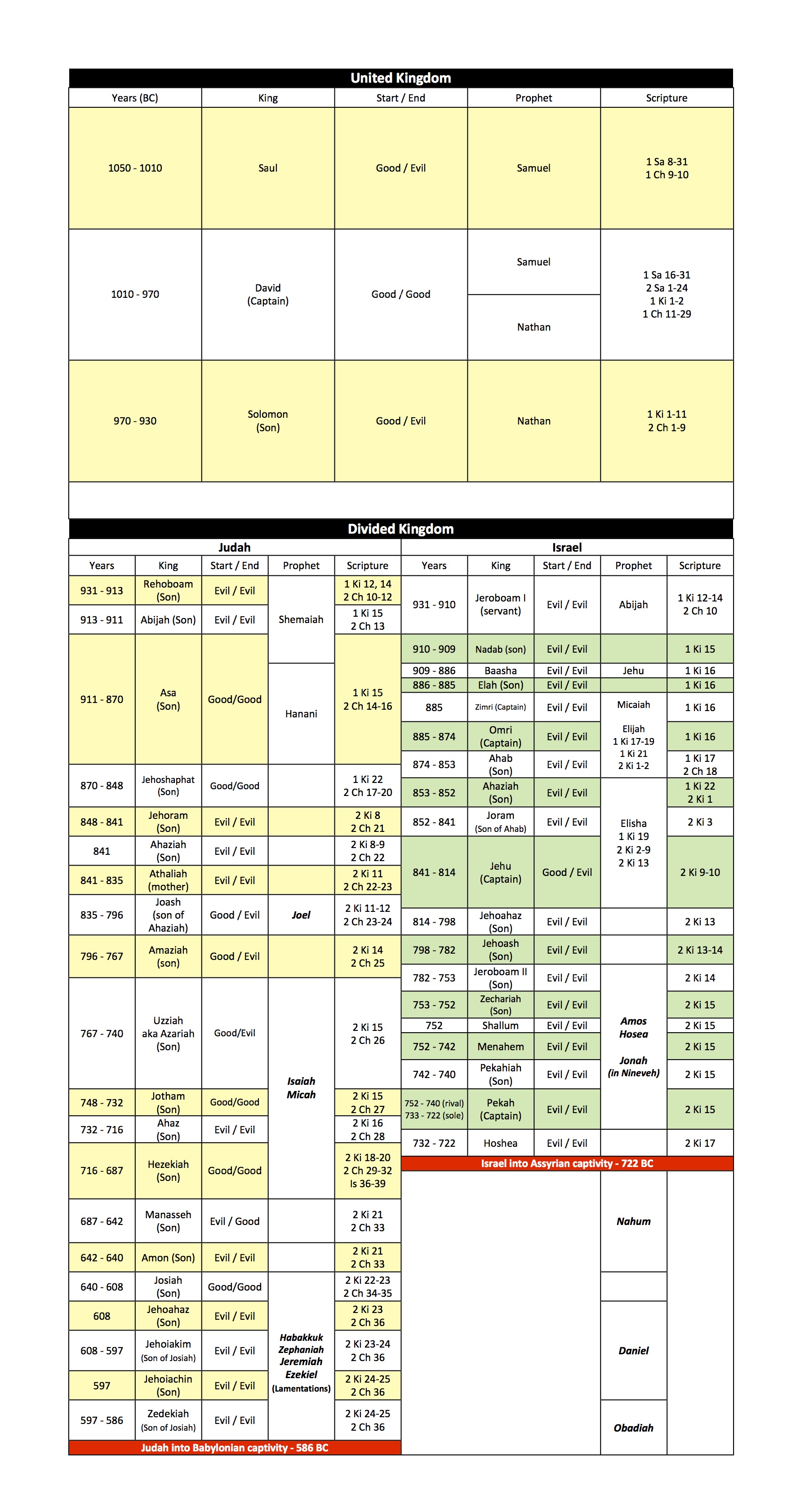
Doing some research lately on the pre-exilic and exilic periods of the Old Testament (building on what I wrote on this blog four years ago), I searched for a list that I used to have, with the rulers and kings of Israel and later Judah. I can't find that list now; it's around her somewhere. Luckily, I found several references online, so I'll save them here for future reference. Perhaps there is someone who is such a Bible scholar as to have all these long names and references memorized, but I'm not one!

Here is a discussion and map of the settlement of the tribes of Israel:
http://www.jewishvirtuallibrary.org/jsource/Judaism/tribes.html

Here is a chart of the judges of Israel, along with the peoples who threatened Israel:
http://www.bible-history.com/old-testament/judges.html

Here is a list of the judges, with the biblical references:
http://jesusalive.cc/ques349.htm

Here is a good chart with the Bible references along with approximate dates, the character of each monarch, AND the prophets associated with the different kings:
https://craigtowens.files.wordpress.com/2014/07/kings-of-israel-judah2.jpg

Also: https://www.biblegateway.com/blog/2014/08/chart-of-israels-and-judahs-kings-and-prophets/

Here is another, without the references, but which is also helpful:
http://www.ldolphin.org/kings.html

And yet another:
http://www.biblestudy.org/prophecy/israel-kings.html

And...
https://www.vtaide.com/gleanings/Kings-of-Israel/kings.html

It would be interesting to print out all these charts and to see different interpretations of the approximate years of each monarch along with the prophets. Some prophets are easier to locate in history than others; the book of Joel, for instance, has little or no internal indication of the writing's circumstances, and so to position Joel historically is conjectural. Also, Daniel narrates exilic circumstances but was written many years later.


Wednesday, March 16, 2016

Maundy Thursday and Good Friday Scriptures

The manuscript for my book, Walking with Jesus through the Old Testament (available here or here), had an appendix that contained allusions and quotations to Old Testament passages that, for the New Testament writers, were pertinent to Maundy Thursday and Good Friday. The appendix was omitted because it didn't fit the devotional quality of the rest of the book. But with my editor's permission, I'm posting that material here on this blog.

The Gospel accounts of Maundy Thursday and Good Friday are filled with allusions and quotations to Old Testament passages. The New Testament authors sought to demonstrate the messianic nature of Jesus by showing correspondence of Jesus' experiences with the biblical traditions. It is so difficult to discuss Holy Week scriptures without sounding anti-Jewish or anti-Semitic; the Gospels were written by Jews about other Jews, but as history moved along, Christianity became a predominantly Gentile religion, and the portrayal of Jews in the Gospels caused Christians to hate and persecute Jews. We must never forget this as we study the scriptures; in my book, I tried to show Jesus' continuity with the scriptures of his religion rather than to take a supersessionist approach.

With all that in mind: if you have time, look up some or all of these passages, so you can appreciate how the Gospel writers interpreted Jesus' experiences as deeply rooted in Hebrew scriptures. The way the Romans treated Jesus reflected their perception Jews as a troublesome people who, in their religious integrity, refused to respect the Roman gods.

Then [Jesus] said to them, “These are my words that I spoke to you while I was still with you—that everything written about me in the law of Moses, the prophets, and the psalms must be fulfilled.” Then he opened their minds to understand the scriptures, and he said to them, “Thus it is written, that the Messiah is to suffer and to rise from the dead on the third day, and that repentance and forgiveness of sins is to be proclaimed in his name to all nations, beginning from Jerusalem.
(Luke 24:44-47)

• Judas betrays Jesus (Ps. 41:9; Matt. 26:14–16; Mark 14:10–11; Luke 22:3–6; John 13:21–30) and receives thirty pieces of silver (Zech. 11:12–13; Matt. 26:14–16; 27:3–7).
• Jesus’ friends abandon him; the sheep are scattered after the shepherd is struck (Ps. 38:11; Zech. 13:7; Mark 14:50).
• The witnesses accuse him (Ps. 27:12; 35:11–12; Matt. 26:59¬–61; Mark 14:55–57).
• Jesus is silent before his accusers (Isa. 53:7; Matt. 27:13–14; Mark 15:3–-5); he does not respond to them with deceit or violence (Isa. 53:12; 1 Pet. 2:22); but he testifies to the victory of the Son of Man (Ps. 110:1; Dan. 7:13; Matt. 26:64; Mark 14:62; Luke 22:67–70).

For Good Friday, Old Testament passages connected to Jesus’ experiences are many.
• Satan will “bruise” him (Gen. 3:15; John 12:31–33; 19:18).
• Jesus will suffer for the world (Isa. 53:4–6, 10-11; Rom. 5:6–9).
• Jesus experienced insults, rejection, and abuse (Isa. 49:7; 50:6; Ps. 22:8; Matt. 27:41–44; Mark 15:31–32;, Luke 23:35–38). He is spat upon (Isa. 50:6; Matt. 27:30; Mark 15:19). People gloat (Ps. 22:12–13, 16; 38:11; 109:25; Matt. 27:39–40;, Mark 15:29–30; Luke 23:35), and they reproach him and mock him (Ps. 22:6–8, 16–18; 44:13–16; 109:25; Matt. 27:27–31, 39–40; Mark 15:16–20, 25–32; Luke 23:35–36;, John 19:19–20).
• He is led as a “lamb to the slaughter” (Exod. 12:3–13; Ps. 44:11; Isa. 53:7; John 1:29; 1 Cor. 5:7).
• He is disfigured and brutalized (Isa. 52:14; Ps. 22:16–17; Matt. 27:26; Mark 15:2; John 19:1–3).
• He is pierced (Ps. 22:16; Zech. 12:10; John 19:33–37; 20:25–27).
• His betrayer dies and the money is used for a potter’s field (Jer. 18:2–3; 32:6–15; Zech. 11:12–13; Matt. 27:3–10).
• He is executed with criminals (Isa. 53:12; Matt. 21:38, 44; Mark 15:27; Luke 23:32–33; 39–43; John 19:18).
• He expresses thirst (Ps. 69:21; John 19:28).
• He is given vinegar to drink (Ps. 69:21; Matt. 27:48; Mark 15:36; Luke 23:36).
• Lots are cast for his clothing (Ps. 22:18; Matt. 27:35;, Mark 15:24; Luke 23:34; John 19:24).
• He makes intercession for those who kill and mock him, and he invokes the compassion of God for them (Isa. 53:12; Luke 23:34, 39–43; Acts 2:36–39).
• He cries, “My God, my God, why have you forsaken me?” which is the first line of Psalm 22 (Matt. 27:46; Mark 15:34).
• He experiences the onslaught of death (Ps. 69:15).
• He declares, “It is finished” (Ps. 22:31; John 19:30).
• He prays, “Father, into your hands I commend my spirit,” which is taken from Psalm 31:5 (Luke 23:46).
• Romans did not break Jesus’ legs, which would have hastened his death; that his bones were not broken connects us to Psalm 34:20, as well as to Passover Scriptures like Exodus 12:43–46 and Numbers 9:12. These Passover texts, in turn, connect us back to the image of Jesus as the Lamb of God.
• God did not abandon Jesus to death, corruption, and anonymity (2 Sam. 7:12–13; Ps. 16:10; Acts 2:31, 31–32).
• He is given another man’s grave (Isa. 53:8–9; Matt. 27:57–61; Mark 15:42–47; Luke 23:50–56;
John 19:38–42).
• Jesus accomplishes God’s salvation (Isa. 25:8, and many others).

Remember that nearly all these Psalm references come from Psalms of King David, connecting Jesus’ sufferings with those of his ancestor David and thus saying something about the kind of monarch Jesus is affirmed to be.

Thursday, March 3, 2016

"The Love of Bible Study"

During the 00s, I worked on a book manuscript of my own (rather than a commissioned work or one resulting from a successful proposal), that was an experiment which, ultimately, found no interested publisher. The title was The Love of Bible Study, and the text can be found here. I wrote as an introduction:

"For many years I’ve written church curriculum aimed at helping people understand the Bible, apply it to personal life, and interpret the text concerning modern topics. For an even longer time, I’ve read the Bible in order to grow in my faith, to clarify God’s will and purposes. For me, reading the Bible is a great joy!

"A few years ago I purchased a new NRSV Bible to replace (but more usually to supplement) the worn old Bible I’ve used since I purchased it for a college course in 1977.  Approaching my 50th birthday, I decided to take notes as I compared the two Bibles. Beginning with that time of midlife spiritual renewal, my notes became a blog called “Changing Bibles,” and then I “farmed out” the posts at that site to this one, and also to a companion site to this one (called Bible Connections), and to yet another site that focuses upon Psalm 121. So these four sites of informal notes and reveries are interconnected as the results of a common midlife resolution to study the Bible anew. My resolution clearly got out of hand, but in a good way.

"At first I hoped that the contents of the present blog would become a published book. But the material did not fit comfortably into a genre: academic study, curriculum, or memoir. So I stopped sending queries to publishers and “cut to the chase” by making my studies available to readers in this online form.

"Thereby, I hope I can help you—you who found this site—discover favorite scriptural passages of your own, and give you a fresh appreciation of the Bible, lengthy and intimidating though it can be for many of us.    

"As we study the Bible, we seek not only to understand things about the Lord but also to seek the Lord himself.  It can be easy for us to forget that the living Christ is right now helping us as we read and study. Thus my blog title has a double sense: we grow in enjoyment of Bible study so that we look forward to it, but we also grow in love of God and one another. We connect Bible passages to Christ, and as we do so we see how the living Christ and the Holy Spirit is present to us today, helping us learn and grow and draw closer to the triune Lord who has already accomplished more than we could think or ask (Eph. 3:20-21).

"Please feel free to comment and raise topics and questions, so that we can have a conversation about faith and life. Also, please feel free simply to browse. I managed to refer to every biblical book (even tiny Obadiah and 3 John), and I quoted or cited a few passages in the Apocrypha, the Talmud, and the Dhammapada. If anything here is helpful enough for you to use, you may certainly do so but if you quote something, please indicate the source."

The site has had only a very modest viewership, a few thousand during the last few years, but hopefully some have found it helpful. It certainly was to me, as I delved into the scriptures with that out-of-hand interest of which I wrote above.


Friday, February 26, 2016

"Walking with Jesus through the Old Testament"

I didn't post very much on this site in 2014 and 2015, partly because of school commitments, and also I was working diligently on a book manuscript for Westminster John Knox Press: Walking with Jesus through the Old Testament: Devotions for Lent. It's available here, and also on Amazon, Cokesbury, and other book sites.

I begin with the story of the walk to Emmaus in Luke 24, which includes the verse: “Then beginning with Moses and all the prophets, [Jesus] interpreted to them the things about himself in all the scriptures” (verse 27). Later, Jesus’ two friends declare, “Were not our hearts burning within us while he was talking to us on the road, while he was opening the scriptures to us?” (verse 32). Although we don’t know which scriptures Jesus discussed, I chose forty Old Testament passages that are especially important for understanding Christ, and wrote meditations on each passage for each of the days of Lent. I began with Jesus' beginnings, moved through the early days of his ministry, connected him with great themes of the Old Testament and with significant Old Testament figures, and then concluded with Holy Week, Easter, and the Holy Spirit. Each day includes a prayer and at least one spiritual exercise.

My hope is that people will enjoy the book as a Lenten study, but it can also be used outside of Lent as a study of important Old Testament passages, and a clarification of its relationship with the New. I stress continuity of the two testaments and try very hard to avoid supersessionism. Many Christians don't care much for the Old Testament, but I love it and wish that more Christians loved and understood it better. So I've hopes that the Spirit can use the book to help folks delve more deeply into the sacred scriptures.


The 613 Mitzvot

A couple years ago, I posted some aspects about the Torah, here. Lately I've been studying a wonderful book book by Harvey J. Fields, A Torah Commentary for Our Times, Volume Two: Exodus and Leviticus (New York: URI Press, 1991). In the chapter on the Parashat Mishpatim (the Torah portion Exodus 21:1-24:18: parashat means section and mishpatim means laws or rules), the author notes that this is not the only Torah section dealing with laws and mitzvot, which are found throughout the Torah, but it does begin a listing of laws following the giving of the Ten Commandments. The author notes that the 4th century Rabbi Simlai was perhaps the first to ask how many mitzvot are given in the Torah, and he gave the classic answer, agreed upon by Rambam (Maimonides): 248 positive commands (“you shall...”) and 365 negative ones (“you shall not...”). The number corresponds to the parts of the human body and the days of the solar year, respectively (p. 53). Other rabbis distinguished mitzvot bein adam le-Makom, or mitzvot “between human being and God”) and mitzvot bein adam le-chavero, mitzvot between a person and other persons. But this distinction between ritual and ethical commandments doesn’t imply that one is more important than the other, and rituals often lead to proper ethical actions (p. 54).

An aside: I know that this is a common Christian idea about the Torah: that ethical commandments are more important than the rituals. That may be true for Christians, but there is no basis in the text or in Jewish tradition.

Another aside: a rabbi friend tells me that about 300 laws can still be observed today. Those that pertain to the Temple, priesthood and sacrifices are not observed because those institutions no longer exist in Judaism, although even those laws can be studied and meditated upon today. Other laws are certainly followed by Jews today, although Jews do differ on issues of contemporary interpretation (just as Christians differ among themselves about biblical topics).

The author Harvey Fields discusses the views of Maimonides and other teachers, that the commandments are given to Jews by God in order to uplift one’s life to God’s will and to submit oneself to discipline (pp. 54-55). This includes the commandments that seem to have no particular connection to ethical improvement, or those for which the meaning is no longer understood. By practicing and/or meditating on the meaning of mitzvot, “we become more just and loving and add to the good n our lives and in the world” (p. 55).

Fields concludes, “the 613 commandments form the essential core of Jewish practice and tradition. Their blend of both the ethical and ritual is unique” (p. 56), for other religions tend to separate the two kinds of teaching.

How about the laws themselves? The Judaism 101 site has a helpful listening of the laws, arranged topically: http://www.jewfaq.org/613.htm She indicates which laws can still be followed and provides the scripture links.

The book I cited in that earlier post is by a Presbyterian author, William J. Doorly, The Laws of Yahweh: A Handbook of Biblical Laws (New York: Paulist Press, 2002). Chapter 6 gives all the laws in order.

Rabbi Joseph Telushkin has a wonderful book, from which I've taken notes elsewhere in this blog: Biblical Literacy: The Most Important People, Evens, and Ideas of the Hebrew Bible (New York: William Morrow, 1997). Part Two pertains to "laws and ideas" (pp. 397-510). Then Part Three gives a short summary and/or discussion of all the laws in order of appearance (pp. 511-592).


Sunday, January 17, 2016

Tribute to Brevard S. Childs

When I attended the Society of Biblical Literature convention this past November, I purchased a book that I'd not yet seen, The Bible as Christian Scripture: The Work of Brevard S. Childs, edited by Christopher R. Seitz and Kent Harold Richards.

Childs (1923-2007), was professor of Old Testament at Yale in 1958 till 1999 (and Sterling Professor in 1992-1999) He was known for his "canonical criticism," which focused upon the biblical text as canon, in contrast to the historical-critical method. He wrote several books, a notable one of which was Introduction to the Old Testament as Scripture (1979). I was very privileged to have him as my Old Testament professor at Yale Divinity School during the Fall 1979 semester, when that book was just beginning to be discussed. I am diligently searching for a letter he wrote to me in the early 00s in response to a grateful letter that I had sent to him.

During these past several years of renewing my personal Bible study, I've enjoyed studying again not only his Introduction book but some of his others. The past few weeks I've been enjoying reading through Seitz's and Richards' book, a tribute and assessment of Childs' work. (I didn't know Seitz but I vaguely remember that he was an Old Testament doctoral student at the time I did my masters degree there.)

The contents of the book:

Preface by Christopher R. Seitz

The Works of Brevard Springs Childs

Tribute to Brevard S. Childs, at the International SBL Meeting in Vienna, Austria, by Christopher R. Seitz.

Brevard Childs and Form Criticism, by David L. Petersen

The Wrath of God at Mount Sinai (Exod 32; Deut 9–10), by Jörg Jeremias

The Contrastive Unity of Scripture: On the Hermeneutics of the Biblical Canon, by Bernd Kanowski

Brevard Childs as a Historical Critic: Divine Concession and the Unity of the Canon, by Stephen B. Chapman

Theological Interpretation, the Historical Formation of Scripture, and God’s Action in Time, by Neil B. MacDonald

Faith Seeking Canonical Understanding: Childs’s Guide to the Pauline Letters, by Leander E. Keck

Childs and the History of Interpretation, by Mark W. Elliott

Biblical Theology and the Communicative Presence of God, by Murray A. Rae

The Doctrine of God is a Hermeneutic: The Biblical Theology of Brevard S. Childs, by C. Kavin Rowe

A Shared Reality: Ontology in Brevard Childs’s Isaiah Commentary, by Mark Gignilliat

A Tale of Two Testaments: Childs, Old Testament Torah, and Heilsgeschichte, by Don Collett

Reflections on the Rule of Faith, by Leonard G. Finn

Childs and the Canon or Rule of Faith, by Daniel R. Driver

Psalm 34: Redaction, Inner-Biblical Exegesis and the Longer Psalm Superscriptions—“Mistake” Making and Theological Significance, by Christopher R. Seitz

Allegory and Typology within Biblical Interpretation, by Brevard S. Childs


Thursday, May 21, 2015

The Pentateuch

This past winter, before the hectic semester began, I took notes from the enjoyable article on the Pentateuch in the New Interpreter’s Bible Dictionary. The author, R. W. L. Moberly, discusses issues of interpretation and content. For instance, narrative tensions can be found throughout the various books. Isaac’s blessing of his two sons (Genesis 27) implies that Isaac was near death; but Isaac died years later, after Jacob returns from his fourteen years with Laban (Genesis 29:15-30, 35:27-29) (p. 432). The number of Israelites who left Egypt seem to be a comparatively smaller group---that can be accommodated by twelve springs and by water produced from a rock (Ex. 15:27, 17:6). But elsewhere the narrative describes the group as 600,000 men on food, not including women and children, or nearly two millions people (p. 433).

Another contrast is the status of women: Exodus 20:17 places “wife” after “house,” while the corresponding commandment in Deuteronomy (5:21) places wife before house. Similarly, Deuteronomy 22:22 makes a woman accountable for her actions, although in Genesis, when Sarah is taken into Pharaoh’s harem (and later Abimelech’s), it is Abraham who is accountable (Genesis 12:18-19, 20:10) (p. 433).

Still another contrast is the difference between the Ten Commandments, usually in small details, but notably in the difference between the Exodus and Deuteronomy versions of the Sabbath commandment, where two different reasons for the commandment are given (Ex. 20:11, Deut. 5;15) (p. 433).

The article lists several similar examples, reflecting the different traditions that have been brought together in the writing and editing of what became the canonical text. But I was particularly interested in points made in the section "Genesis as ‘the Old Testament of the Old Testament’" (p. 434-435). The focus is on the fact that, in Exodus 3:13-15, God reveals the divine name to Moses as a new name, and in Exodus 6:2-3, it is stated that the patriarchs knew God, not as YHWH but as El Shaddai. But in Genesis, God uses the divine name (Gen. 15:7, 28:13), and the name is frequently used throughout the book (p. 434).

A possible explanation is that, for the hypothesized writers named as the Elohist and the Priestly sources, the divine name was made known to Moses but not before, while the source called the Jahwist used the divine name all along, in Genesis 2, in Gen. 4:26, and so on. Still, these different traditions were preserved together when Genesis was written. (Another explanation is that the divine name was familiar to the authors and used in the test, even if it is anachronistic: p. 435.)

Moberly writes that the divine name becomes attached to the covenant of Moses and therefore to holiness and exclusivity (as in Exodus 12, where the Egyptians did not known the true God.) And yet, the Lord named by the divine name YHWH is traditionally called the God of Abraham, Isaac, and Jacob---Moses' forebearers. As Moberly puts it, “The one God can apparently be known in markedly different ways. This poses the ancient problem: how should one recognize as religiously authoritative material that is full of religious practices different from or even forbidden by Mosaic torah (compare, e.g., Jacob’s setting up a pillar in Gene. 28:18 with the strong prohbition of such in Deut. 16:22)?” (p. 435).

Moberly suggests that the patriarchs “become types and/or figures of Israel” for instance, Abraham’s journey to Egypt. The Abraham stories aren’t rewritten to reflect later religious realities but they remain authoritative heritage for Israel. Christians, of course, do the same thing in their interepretation of Abraham, Moses, and other aspects of the Old Testament (p 435).

Another interesting point made in the article concerns the Shema, not only Deut. 6:4-5 but also Deut. 6:6-9. Christians tend to ignore 6-9 as Jewish practices. Yet Christians feel scriptural obligations to follow other teachings of scripture (as in the "do this" of 1 Cor. 11:23-26, et al.). It’s just that Christians have appropriated other practices for their own heritage. "Of course, some Christians traditionally have practiced equivalent to those of Deut. 6:6-9, most obviously int he regular recital of the Lord's Prayer and in the display of the prime Christian symbol of the cross---often on a necklace but also over the gates of critics in the historic Christian empire of Byzantium, where they symbolically depicted the identity and allegiance of the place one was entering, just as Deut. 6:9 envisages the working of the Shema doing for Israel's homes (private space) and cities (public space). Deuteronomy does not envisage the recital and display of an equivalent to the Shema, but of the Shema itself. Yet Christians only receive Deuteronomy as part of the larger canon of Scripture… and that makes the difference" (p. 437).


Sunday, August 10, 2014

Traveling Mercies

I met the Old Testament professor Walter Brueggemann the other day. I was working on a new writing project at our nearby coffee shop, and he came in for coffee because he was in town for a local event. I was a little starstruck as I introduced myself and told him I used his books in some of my classes.

A few days later, my project took me into his commentary on Exodus (1), and I was intrigued by his thoughts about the tabernacle. As always on this blog, my thoughts here aren't "mine" at all but are notes about the Bible from books I like.

Here is the concluding paragraph (NRSV) of Exodus:

Then the cloud covered the tent of meeting, and the glory of the Lord filled the tabernacle. Moses was not able to enter the tent of meeting because the cloud settled upon it, and the glory of the Lord filled the tabernacle. Whenever the cloud was taken up from the tabernacle, the Israelites would set out on each stage of their journey; but if the cloud was not taken up, then they did not set out until the day that it was taken up. For the cloud of the Lord was on the tabernacle by day, and fire was in the cloud by night, before the eyes of all the house of Israel at each stage of their journey.

Brueggemann contrasts the presence of the Lord in the tabernable, with the fact that the tabernable by its nature is portable for the Israelite’s journey. Sometimes it is the Ark of the Covenant that “contains” the presence (as in Numbers 10:33-36). In this Exodus text, the presence is contained in the cloud and the fire. “One can see that, in the collage of ark-cloud-fire-glory, Israel struggles to articulate presence that is powerfully known and confidentally trusted but that has not been made directly available for administration” (p. 979).

This articulation of presence has its dangers, as in priestly elitism, and overstatement concerning presence. Nevertheless, the presence of God in the tabernacle shows “God’s own resolve and commitment” to the community, to limit God’s freedom as it were to accompany the community journeying “in a world of emptied, one-dimensional profanation” (p. 979).

The dual themes of “abiding presence” and “traveling fidelity” continues in the New Tetament, with Jesus abiding with his people (e.g., John 14:23) and journeying “on the way” with the disciples---and authorizing them to journey and travel, too, as he is promises to be “with you always” (Matt. 28:19-20) (p. 980). It isn't just a matter of God's omnipresence, but also God's pledge to accompany us.

In this passage there is also the powerful theology of “traveling mercies.” Brueggemann points out that the promises of God’s presence has already been seen in Gen. 28;15 and 46:4), and see see it here, as well as the psalms. (p. 980).

Even though I walk through the darkest valley,
   
I fear no evil (Ps. 23:4a).

Because you have made the Lord your refuge,
   
the Most High your dwelling-place, 

no evil shall befall you,
   
no scourge come near your tent. 

For he will command his angels concerning you
   
to guard you in all your ways. 

On their hands they will bear you up,
   
so that you will not dash your foot against a stone. 

You will tread on the lion and the adder,
   
he young lion and the serpent you will trample under foot (Ps. 91:9-13).

The Lord is your keeper;
   
the Lord is your shade at your right hand. 

The sun shall not strike you by day,
   
nor the moon by night. 

The Lord will keep you from all evil;
   
he will keep your life (Ps. 121:5-7).

Our dearest theological ideas have to come from somewhere, and the promise that God accompanies the faithful is rooted here in Torah.

Note:

1. Walter Brueggemann, "The Book of Exodus," in The New Interpreter's Bible, vol. 1 (Nashville: Abingdon Press, 1994).

Saturday, August 2, 2014

Journeys Home to God: Hosea

from oca.org
Researching the Bible for a new writing project, I was intrigued by Gale Yee’s commentary on the book of The New Interpreter’s Bible (Vol. VII, Nashville: Abingdon Press, 1996). Our Sunday school class in Ohio had studied Hosea for a time, became downhearted by the many prophetic warnings, and switched to something more cheerful: Lenten scriptures! But I enjoy reading about how the seemingly random and difficult texts of the Prophets fit together, in ways that you're likely to miss unless you have a good commentary in hand. In this case I also enjoyed learning that there are “journeys home” motifs in Hosea.

1. The book has three sections chapters 1-3, 4-11, and 12-14. Chapters 1-3 concern Hosea’s relationship with his adulterous wife, Gomer, and their three children. But the people of Israel worship false Gods, which is “adultery” to God. God wants to reconcile with his “wife,” as Hosea does so with Gomer (ch. 3) (p. 198). As Gomer loves many men, the Israelites love the Canaanite fertility gods, the baals (p. 200).

2. Chapters 4-11 change the metaphor of God and Israel to parent and child; here, the child is rebellious. As with an adulterous wife, a rebellious child could be punished (p. with death but God does not want that, as summarized in the well known chapter 11 (p. 198). In 12-14, the two metaphors are interwoven, again with a good ending as land is restored to beauty and bounty (p. 198).

3. Within each section are important structures, as illustrated by the way chapters 3, 11, and 14 conclude the sections. The sections tell part of a story: of Hosea and Gomer, of God the husband and Israel the wife, of God the parent and Israel the child. Each section also has a “journey motif”: of the wife/son making a journey back to the huband/parent, and of the people journeying from exile back to the land (p. 198). For instance, as the earlier israelites journeyed from Egyptian exile to the land, so will the “son” (the people of Hosea’s time) journey back to and enjoy the good land, if they repent (11:10-11) (p. 235).

4. With these journey’s of repentance to faith and of exile to home, there are also journeys from barrenness to bounty, with the fertility of the wife (a theme elsewhere in scripture) symbolizing the fertility of the land (p. 198). “Hope” passages (5:15-6:3, 10:12, 11:10-11) are included in order to help motivate readers, too, to repent (p. 234). In chapters 4-11, the journey from barrenness to fertility begins at 6:1-3 (p. 250). Needless to say, Hosea believes that fertility does not come from the baals who are gods of the rain, but from the true God who is creator and lord of all creation (p. 200).

5. Interestingly, too, the worship of baals was an intrinsic part of worship of the Lord, as reflected in Hosea (3:4, 4:11-19, 10:1-2, 5, 8, 9:1-3, 13:2, 14:8). The baal worship was itself a “journey” of barrenness and death toward newness of life, and although the exact nature of this combination of Israelite and Canaanite worship is now difficult to reconstruct, the Israelites would not have thought such practices inappropriate. Hosea, of course, strongly condemned Baal worship as adulterous and rebellious (pp. 202-203).

6. Also interesting is the relationship of the 8th century Hosea and 6th century deuteronomistic history. The condemnation of idolatry is a strong theme of both, and Yee discusses the possible influence of Hosea upon the later history as well as redaction and editing of the Hosea material (pp. 204-206).

7. Memory is a component of the journey. Hosea connects the people of his time back to the earlier Israelites who journeyed from Egypt to the land (9:10, 11:1, 11:3-4). Of course, the faithfulness and provision of the Lord is the key thing to remember and reclaim (p. 279).

8. Unfortunately, the people of Hosea’s time were, indeed, cast into exile when they were defeated by the Assyrians. As Yee writes, "the Hosean text challenges us to reckon seriously with the religious and political choices before us… Hosea warns us that we, too, can ‘return to Egypt,’ if we turn a blind eye to racial/ethnic tensions and hostilities in our midst” (p. 279).

Themes of marriage and parent/child continue in the New Testament. God's Son Jesus Christ is, of course, one of God's people the Jews. Seeking a non-supersessionist way to think about this, I would say that rabbinic Judaism continued to strive to be faithful to God's Torah as Christians look to Christ who redeems the church as the in-grafted branch. Paul uses the marriage imagery to speak of the relationship of Christ and the church as analogous to God toward Israel and to the husband-wife relationship.


Tuesday, June 11, 2013

Moving Over to "Journeys Home"

Because of increased upcoming work in college and seminary course preparation, and a grant proposal that I plan to write for an early fall deadline, I'm going to stop posting at this blog for the time being. But I still continue to post regularly at my "Journeys Home" blog, accessible here. Posts at that blog will include short Bible studies and meditations, as I've already been posting at both sites. Feel free to continue browsing my posts at this site and the essays at my "Love of Bible Study site, accessible here.

Monday, June 10, 2013

Staying Strong in Faith

Have you ever noticed the New Testament disciple Demas (Δημᾶς, pronounced day-MAS)? Possibly not, since he only appears three times, at the end of letters.

My mom used to own a collection of Harry Emerson Fosdick's sermons, and in one sermon he made a hypothetical case about the stages of Demas' loss of faith (or, at least, Demas' commitment to Paul's difficult ministry).

Fosdick noted that, in Philemon 23-24, Paul lists him ahead of Luke. Here is the NRSV:

Epaphras, my fellow prisoner in Christ Jesus, sends greetings to you, and so do Mark, Aristarchus, Demas, and Luke, my fellow-workers.

Then in Colossians 4:14, among his greetings and acknowledgments, Paul (assuming Pauline authorship of this letter) mentions Luke first, and then Demas:

Luke, the beloved physician, and Demas greet you. 

In 2 Timothy 4:9-11, Paul writes:

Do your best to come to me soon, for Demas, in love with this present world, has deserted me and gone to Thessalonica; Crescens has gone to Galatia, Titus to Dalmatia. Only Luke is with me. Get Mark and bring him with you, for he is useful in my ministry.

Fosdick suggested a regression of Demas' devotion: first he is listed ahead of Luke (implying his importance to Paul), and then he is listed after Luke, implying a drop in importance. In the third verse, Paul regrets that Demas has abandoned him because he loved the world more than the Gospel. (I read that the name is used by John Bunyan for a deceiver in The Pilgrim's Progress.)

Perhaps that isn’t fair. It's not hard to imagine that Paul wasn’t easy to get along with! Paul, like many preachers following him, was singleminded in his efforts. I remember a pastor whom I met casually years ago. He made the comment to someone that Satan had been sending him the wrong persons to assist in his ministry. I thought that was a rather arrogant thing to say. He should have been more humble and said that his assistants had so far been incompatible with his own personality, style, and goals, which does happen in workplaces.

But one’s religious faith and devotion can certainly flag. That's not hard to imagine, either. Many times my faith has become tired and discouraged, especially in the face of difficulties outside my control and times of distress. Tired of feeling worried about certain things, I'm currently seeking God's help to grow in my trust in the Lord.

Thus, in Paul's letters as well as Hebrews and also the Gospels, that we should seek to stay strong in our faith and not to lose heart.  Just two passages that come to mind: 2 Cor. 4:16-18 and Gal. 6:9. Can you think of others?

One hopes that Demas found other chances to be a disciple, just as we all hope that God continues to work in our lives when we are weary, or when we drift or stumble.


Sunday, June 9, 2013

Jesus Has Compassion

Sermon for the 3rd Sunday of Pentecost.... My parents are both gone now. My mother died this past September and my father died back in 1999.  Like everyone else, I struggle to have a growing faith and to have a peaceful, trusting heart in the face of life’s difficulties, which definitely isn’t always easy. Grief from a family loss is a very major thing to face. I have to say, though, that all the biblical promises of eternal life and heaven helped me tremendously as I contemplated the fulfillment of those promises for my mother, who was 93 and had been ill and infirm for many years.

I like to think of Christ's death and resurrection as bringing about a kind of reality, which is forceful and real for us today. Our sins and wrongdoings and failures (and our smallness in the universe) have no more force to separate us from God, because we’re protected in that resurrection reality.

Eternal life is like being kept in a protective and secure place, out of reach of danger. Obviously, we still face difficult and dangerous, painful situations. But if we have a relationship with Christ, then Christ keeps us out of reach of the full powers of death and evil. Our very lives are tucked away and protected, because we’re already sharing in the divine life of Christ. We have a new identity for the remainder of our physical existence, characterized and empowered by God’s tremendous and infinite love.

Nothing we do in this life can separate us from God’s great love, because we have already died and been buried, so to speak, because the physical death we will eventually----awful as death is---has been rendered impotent as far as our eternal life is concern.   Now, we continue to live our physical lives, which are temporary and ephemeral, but our true, new life, which is in God, is “hidden with Christ.”  Baptism is a sign of this safekeeping, our “burial” with Christ, so that as Christ is buried we are buried with him, and as he has risen from death so too will we be raised to eternal life.

These two stories, from 1 Kings and Luke’s gospel, are traditionally paired together. If you study them side by side, they parallel one another. Scholars think that Luke must have written the story in order for it to parallel the Elijah story, since structurally and thematically they’re very similar.

Elijah and Jesus both approached the gate of the town, they both immediately met a widow whose son had died. Both Elijah and Jesus had compassion, with Elijah’s expressed as a cry to the Lord and Jesus’ by the time he took to address the situation. Also, Elijah’s compassion was expressed in the way he reached out to a Gentile woman, while Jesus reached out to someone who was simply passing by while he was doing something else. In both stories, the son is given back to the mother, and also in both stories, Elijah and Jesus are both recognized as persons from God.

When I took an introduction to religion course during my freshman year of college, I learned my first “cool” biblical word, and it happens to be used in Luke’s story. The Greek work is splagchnizomai, which is translated “to have compassion,” but it is euphemism because the literal meaning is “to feel yearning in the bowels”---or, as we might say, “to feel it in the gut,” a gut feeling.  In other words, Jesus felt compassion in his deepest inner being.

This is an important thing to remember in this story, as Jesus was moving along with a large crowd following him and the disciples. He noticed another large crowd---dueling crowds, so to speak, but this second crowd was following the widow and her dead son. One of my commentaries quotes the epistle from James, that true religion is “to care for orphans and widows in their distress” (1:27). Obviously Jesus had power to help the widow and raise up the Son, but hypothetically he could have going on his way without discovering what the other crowd was about.

Jesus’ reaction, though, was compassion.

I’d like for us to think about that for a minute. One day my mother made an offhand comment that she wondered if she was good enough to go to Heaven.  I kind of hit the ceiling---because she was a lifelong churchgoer and I wished she had a more confident understanding of the gospel. But as we chatted, I did wonder if we do a good enough job communicating to people that salvation is a free gift.
Being with God in our life and after our death is completely a gift from God.  Jesus said, “In my Father’s house are many rooms, I go to prepare a place for you.” Jesus didn’t say, “I go to prepare a place for you but only if provide good drywall and do the wiring.” It is completely Christ’s work that gets us a room in Heaven.

But I think, how sad it would be if you were a person in a hard situation, many very scared and the thing you needed most was a message of God’s great love and God’s free gift of salvation. But you feel like you should've volunteered more at church, you should have done this or that, you didn't resolve this or that conflict.  Sunday, the pastor might be preaching sermon about how you need to step up and volunteer more. You end up climbing to the notion that you have to earn God’s grace and work hard to get to Heaven.

But our scriprtures this morning teach us that Jesus responds with compassion to our weaknesses and our struggles.  When we’re at the end of our lives, he isn’t checking his notes to see if we’ve passed muster with him, like a fussy boss----he has already surrounded us with more love than we can realize.

That might be just a good all-around phrase to memorize and recite to ourselves when we’re in a bad way, and in particularly if we’re facing our own mortality: “Jesus has compassion....”


Thursday, May 30, 2013

The Parable of the Talents

Continuing my off-and-on project of reading about Jesus’ parables (1), I looked up the parable of the talents---a scripture that inspired me when I hoped to deepen my faith during my college years. I already knew that a talent “in the biblical sense” was a unit of mass and value, and that the word had come down into the English language to mean an ability or skill. Like many of us, I read the now-double meaning of talent in a symbolic sense, which spurred and encouraged the stewardship of my abilities.

The parable is found in Matthew 25:14-30 and Luke 19:11-27. Here is Matthew’s version:

For it is as if a man, going on a journey, summoned his slaves and entrusted his property to them; to one he gave five talents, to another two, to another one, to each according to his ability. Then he went away. The one who had received the five talents went off at once and traded with them, and made five more talents. In the same way, the one who had the two talents made two more talents. But the one who had received the one talent went off and dug a hole in the ground and hid his master’s money. After a long time the master of those slaves came and settled accounts with them. Then the one who had received the five talents came forward, bringing five more talents, saying, “Master, you handed over to me five talents; see, I have made five more talents.” His master said to him, “Well done, good and trustworthy slave; you have been trustworthy in a few things, I will put you in charge of many things; enter into the joy of your master.” And the one with the two talents also came forward, saying, “Master, you handed over to me two talents; see, I have made two more talents.” His master said to him, “Well done, good and trustworthy slave; you have been trustworthy in a few things, I will put you in charge of many things; enter into the joy of your master.” Then the one who had received the one talent also came forward, saying, “Master, I knew that you were a harsh man, reaping where you did not sow, and gathering where you did not scatter seed; so I was afraid, and I went and hid your talent in the ground. Here you have what is yours.” But his master replied, “You wicked and lazy slave! You knew, did you, that I reap where I did not sow, and gather where I did not scatter? Then you ought to have invested my money with the bankers, and on my return I would have received what was my own with interest. So take the talent from him, and give it to the one with the ten talents. For to all those who have, more will be given, and they will have an abundance; but from those who have nothing, even what they have will be taken away. As for this worthless slave, throw him into the outer darkness, where there will be weeping and gnashing of teeth.”

Luke 19:11-27 has the same story but with some differences. For instance, the man becomes specifically a nobleman who goes to a far country “to get royal power for himself.” Luke’s version also ends slightly differently:

“Why then did you not put my money into the bank? Then when I returned, I could have collected it with interest.” He said to the bystanders, “Take the pound from him and give it to the one who has ten pounds.” (And they said to him, “Lord, he has ten pounds!”) “I tell you, to all those who have, more will be given; but from those who have nothing, even what they have will be taken away. But as for these enemies of mine who did not want me to be king over them—bring them here and slaughter them in my presence.” 

Eugene Wehrli notes that although the parable concerns money, it “must not be treated as a story about the correct use of money” (p. 75). Nor should we think the master is an exact representation of God or Jesus, since this master is not the most upright master, seizing things and acting so harshly that his servants act fearfully. The parable is meant to illustrate something rather than to make that particular character a figure for God.

One difficulty in interpreting the parable, writes Wehrli, is following the reasoning. The third servant takes care of the money, too, seemingly in a responsible way. Wehrli’s analogy is a woman who is entrusted with a valuable vase, who then locks us up away from her rowdy children so that the vase can be returned undamaged, which seems reasonable and responsible. But the master had expected gain on his trust, which the other servants were astute enough to realize.

Returning to the idea of gifts from God, Wehri writes, “God’s gifts are not to be merely preserved; they must bear additional fruit.... The man with the one talent protected what was given him but was unwilling to venture it. This is like honoring religion...but refusing to live by its power. This is also like being unwilling to invest one’s life and risk all for the sake of God” (pp. 76-77).

He comments that among differences between Luke’s and Matthew’s versions, Luke introduces the context of the parable differently---Jesus’ followers expected the kingdom to come soon. Also, in Luke’s version, all the servants get the same amount. The basic thrust of the parable, though, is the same.

Seeking an original context for the parable, Wehrli comments that the story seems to be directed toward the Pharisees. Jesus was criticizing their faith, which (in Wehrli’s words) “puts a hedge around... faith to keep it from being contaminated. Instead of investing it or putting it to work in the world, [the Pharisee] keeps it pure by isolating it from bad influences” (p. 79). If the religion person----anyone, not just the Pharisees of Jesus’ time---has discourse and interaction with others but keeps faith to oneself, one has not recognized the purpose and value of faith.

I must interject an important point here: It’s so easy for Christians to read these scriptural accounts and then assume that Jesus’ words characterize Jews and Jewish teachers today, as well. This is wrong. I can testify that my Jewish friends and colleagues are all about putting their faith to work in the world---to the responsibility of “healing the world” (tikkun olam). My Jewish friends continually inspire me to make my own religious faith more devoted to service to the needy and to interpersonal peace. The qualities Jesus criticized in the Pharisees (who had a specific historical reason to be scrupulous in their devotion) are hardly unknown among persons of nearly any religious faith.

Jeremias also discusses the parable (pp. 58-63) agreeing that, in the presumed original context of the story, Jesus would not have identified him or God as the despot of the parable. Nor was the original parable necessarily about the delay of Christ’s return. (The early church could have seen the parable as an allegory for the Second Coming, in the theme of the master’s delay and the subsequent punishment of the third servant. Likewise, the brutality of the nobleman at the end of Luke's version could refer to the harsh justice that awaited the wicked at the Last Judgment.) Jeremias, too, sees the original target of the story as the Pharisees and scribes, trusted with the treasure of God’s teachings but unwilling to risk them.

Interestingly, Jeremias notes that the parable also appears in the non-canonical Gospel of the Nazarenes, in which the third servant has been rewritten (and moralized) into a wicked person who squandered his master’s wealth “on harlots and flute-players” (p. 58).

I suppose many of us---myself included, especially when I first encountered the parable---read it somewhat allegorically. God is the master who gives us talents (i.e., skills), expects us to use them for God’s kingdom, and is displeased if we let them languish. I had several modest talents, and so this call to God’s service stirred my heart.

As these authors note, the parable’s original form was likely a “jab” at the Pharisees and was more analogical than allegorical. But the point is always apropos: the treasure of God's teachings is not something to keep to ourselves but is meant to be a blessing and a healing power to the world.

******

(1) Exploring the Parables by Eugene S. Wehrli (United Church Press, 1963), and The Parables of Jesus by Joachim Jeremias (Charles Scribner’s Sons, 1972).

Friday, May 24, 2013

Participants in the Divine Nature

This coming Sunday is Trinity Sunday. The Trinity is a challenging doctrine, with technical language.
United Methodist Memes
During my doctoral studies, I researched the doctrine in the theology of Karl Barth.

Ever since the work of the post-Nicene fathers, the divine nature is said to subsist in the three "persons" (personae, prosopa): the Father who is the incriminate origin of the Son and the Spirit, the Son who is the Logos made flesh, and the Holy Spirit who proceeds from the Father and the Son. Barth prefers the Patristic idea of tropos huparxeos (or modus entitativus, or Seinsweise), rather than prosopon, in order to preserve both the unity and tri-unity of God. He stresses that God’s tri-unity (Dreieinigkeit) points to God’s essential relational being, “in which the being of God for us is not something foreign to God’s essence but is grounded in his very being” (Church Dogmatics, I/I, p. 359f).

Because God’s essential (not accidental) nature is relational, God’s self-revelation to human beings takes us into a union with God. Any knowledge of God is also a sharing of the life and being of God in that God’s self-revelation is the nature of God in God’s tri-unity. This is not supposed to be a theopoiesis of human being but rather a gathering of humans into a saving relationship. Nor is it a mystical union, because God’s self-revelation is a wholly free act of God and never a miracle that we can objectify or claim, even in prayerful mysticism.

Jesus Christ is God’s “being in act.” The Trinitarian doctrine of perichoresis (the natures of the persons of the Trinity mutually permeate and condition one another) grounds the nature of God in his three ways of being and in his being for us (pro nobis). Knowledge of God is inseparable from God’s Lordship in Christ. But not only do we know who God is because of Christ, we also thereby know one another as fellow human beings whom we can serve gladly. That is because Christ’s human nature is not something foreign to his divine nature, but it, too, is essential to the being of God. So Christ not only reveals God but also essential, social human beings.

Barth's trinitarian "model" is not the only one. Duncan Reid, in his book Energies of the Spirit: Trinitarian Models in Eastern Orthodox and Western Theology (Scholars Press, 1997), explains distinctions in the doctrine. He notes that Aristotle distinguishes power or attributes (dunamis, from which we get words like "dynamic"), essence (ousia), and energy (energeia); in human beings, for instance, power is the potentiality and energy the actuality of our essence. In Western trinitarian theology (in the tradition of Augustine), God's potentiality, activity, and essence are the same: God is identical in being and action. This is why the West insisted on the filioque: because the western church so emphasizes God's being and action (the imminent and economic trinity); the consubstantiality of the Son with the Father are crucial, and the Spirit must be understood as proceeding from the Father and the Son. Eastern theology (the tradition of Origen, Athanasius, and the Cappadocians, etc.), tended to see power and energy as synonyms, so that God's energeia is identified with God's attributes. For Orthodoxy, this better ensures God's real presence in the created world. Especially, the distinction allows us to say that human beings (and the whole of creation) are invited to be "taken up (analêpsis) into the divine energy" so that we "become God" (theos ginetai), or deified (Reid, chapter 1).

These are all very subtle distinctions, but ones that are crucially important in their implications for other doctrines like justification and sanctification.

When I first posted these thoughts, I also pulled another books off the shelf, What Do Other Faiths Believe? (Abingdon, 2003). My interviewee for Sikhism explained his faith:

“Our scripture starts with a word, Ik Onkar... If you miss the meaning of that word, you’re going to be following the rituals but not the sense of the faith. If you followed and understood the meaning of that word, the rest of it falls into place. Ik Onkar means, ‘there is only one.’ There are not two. That one, is God. Once I understand that, you and I are not two. Just like I have two hands and two legs, my leg is not the same as my hand but they are one, a part of this body. If someone cuts off my hand, it is no longer part of the body; it cannot function. If we are an extension of that ultimate God, and that’s all we are, so our purpose in life becomes very clear to us: to serve that greater body” (pp. 72-73).

He explained that when we misunderstand our true identity, we think of ourselves as an “I,” something separate. But that is a very basic and serious error. Our true identity is as part of a whole, which is God, and thus our purpose in life is to serve one another. My interviewee said that, when we serve ourselves, we become analogous to a cancer cell. He noted that our goal is to add value to the universe. For instance, “If you are serving a customer, rather thinking, ‘How can I sell him something?’ now you can ask, ‘How can I add value to him?’ I am in the listening mode and try to find out ‘What does he need?’ Then I come around and serve that. Everywhere you see success happening, it has this ingredient present" (pp. 74-75).

Here are two different religions that affirm the ontological sociality of human beings, rooted in the being of God. In Sikhism, God is understood as the one God with whom we share our being. In Trinitarian Christianity, our sociality is grounded in the being of God pro nobis. One is a matter of understanding the true nature of our relation, the other is a matter of our being brought into a saving relationship. One is an impersonal God of infinite qualities, the other is a personal God whose very being is in relationship. In both cases, we do wrong, and fundamentally betray our human nature, when we serve only ourselves.

I had bookmarked an article, http://www.huffingtonpost.com/beth-green/human-divine_b_861196.html?ref=fb&src=sp, which affirms the divine nature in human beings. In some religious systems, human beings are understood to be a part of the divine. The non-dualism tradition of Advaita Vedanta, for instance, there is no essential difference between the Universal Spirit (Brahman) and the individual soul (jivatman). Differences that we perceive in reality are actually illusion (maya) and therefore true understanding (jnana) comes from understanding maya. Obviously, then, there is no essential difference between humans and the Universal Spirit (nor between humans and other life forms). Other schools of Vedanta, like Vishishtadvaita, understands the soul and God to be different yet similar, while Dvaita understands souls, God, and the material world to be all separate realities and yet eternal.

As I kept thinking about all thing----going on a trinitarian journey, so to speak---I leafed through my Bible for passages that teach our unity with God and with one another.

A wonderful passage is Jesus' prayer in John 17. I probably shouldn't quote the whole thing here, for copyright purposes, so I'll just ask you read the whole thing with the ideas in mind: Jesus' unity with God, Jesus' unity with his followers and friends. What is the nature of our unity with Christ? Christ is glorified in us (vss. 10, 22-23), and Christ guards us (vs. 12-13), and although we do not belong to the world (vs 16) we are still here and are sanctified in Christ's truth (vs. 17). But that glory, protection, and sanctification are directed toward Christ's prayer that those who believe, and those who will believe, "may all be one. As you, Father, are in me and I am in you, may they also be in us, so that the world may believe that you have sent me (vss. 21-22). Likewise, Christ prays "that the love with which you have loved me may be in them, and I in them" (vs. 26).

I'm a very proud American, but I worry that the individualism and self-sufficient spirit that pervades our culture deters us from being able to appreciate and implement the unity we have with one another in Christ. One sees so many individualistic behaviors in congregations, which you could describe as "my way or the highway," "I pulled myself up by my boot straps," "you have to cover your ass to make it," and so on. We can be very stubborn and set-in-our-ways people who love our relationship with Christ but become snooty, or busy, or unconcerned when we think about being in unity with one another. I'm as private and self-sufficient as the next person.

Perhaps we should put John 17 on the walls of churches so that we remember that we are one with one another in Christ!

But if we did that, we should put Ephesians 2:11-22 on the walls, too. Read that passage, too. This is a similar and powerful biblical vision of our God-given unity with one another. God has removed the boundaries that separate people---but, of course, we persist in retaining them or building new ones.

And also---while we're attaching signs to walls---John 14 would be another excellent passage to remind people, on a weekly basis, of the role of the Holy Spirit. The Spirit's role is absolutely crucial because Jesus is not present with his disciples any longer: his death requires his absence. But the risen Christ and the Holy Spirit abide in us and lead us to love God and one another.

There are other passages, like 2 Cor. 6:16:

What agreement has the temple of God with idols? For we are the temple of the living God; as God said,
"I will live in them and walk among them,
and I will be their God,
and they shall be my people."

We could trivialize the passage a bit when we turn it into a health-related thing: we ought to take care of our bodies because our bodies are God's temples. We miss a deeper point: God's very presence dwells with us as the same God once dwelled in the Jerusalem Temple, but God's act of dwelling puts us in proximity to God's holiness--which, in turn, demands holiness from us.

2 Peter 1:4 is a good related verse:

Thus he has given us, through these things, his precious and very great promises, so that through them you may escape from the corruption that is in the world because of lust, and may become participants in the divine nature.

Good themes for our prayers and meditations for this Trinity Sunday are these: what are ways we become temples of God's Spirit (if we even want to be)? How do we "participate in the divine nature"? How do we understand the divine nature so that our ideas about God and ourselves (while not necessarily disrespecting other people's faith) is uniquely Christian?