Thursday, July 7, 2016

Paul's Missionary Journeys

Parthenon
A few weeks ago we visited Athens during my wife Beth's business trip there. We took an island cruise, visited the Acropolis and a Roman agora and several Orthodox churches, and loved the outstanding Byzantine and Christian Museum, a short walk from the Greek Parliament.

Although seeking out the religious heritage of the area, we did nothing that pertained specifically with the Apostle Paul and his "missionary journeys." But the biblical narratives of early Christianity were in the back of my mind.

I haven't studied the book of Acts very closely
Porch of the Caryatids
on the Erechtheion
for a long time. I tend to prefer Paul's letters. But the "journeys of Paul" is one of those blocks of biblical geographical material---like post-Noah migrations of Genesis 10-11, the tribal allotments in Joshua and the Israelite kingdoms of 1 and 2 Kings---which can be rewarding to study.

I found one website that gives an approximate chronology of Paul's life.
http://www.biblestudy.org/apostlepaul/timeline-life-of-paul-from-first-missionary-journey-to-death.html

Then I took down a favorite book that my grandmother gave me when I was 14: The Zondervan Pictorial Bible Dictionary, Merrill C. Tenney general editor (Zondervan, twelfth printing 1971). In the center of the book, following page 624, there is a section called "The Journeys of St. Paul," with clear plastic pages that you can place over the map of Greece and Asia Minor, to see the approximate routes of Paul's travels.

That same section has summaries of Paul's travels. This is a lot to quote, but I copied the material here for my own interesting:

"First Journey of St. Paul. Acts 13:1-14:28. The church at Antioch 'set apart' Paul and Barnabas for 'the work whereunto I have called them' and they sailed to Salamis on Cyprus, Barnabas' native island. Assisted by John Mark, they preached at Salamis and then journeyed across to Paphos, from which port they sailed to Perga in Pamphylia where Mark left them. From this point they invaded Asia Minor, touching Antioch in Pisidia, Iconic, Lystra, where Paul was stoned and left for dead, and Derbe. Retracing their steps, they further instructed the converts and organized them into churches with properly selected leaders. Sailing from Attalia, they returned to their starting point in Syrian Antioch.

Hydra
"Second Journey of St. Paul. Acts 15:36-18:22. Because of contention with Barnabas over John Mark, Paul chose Silas as his companion on the second journey. Leaving Antioch, they visited churches in Syria on their way to Derbe and Lystra. Here Timothy joined them and they traveled throughout Phrygia and Galatia. At Troas they received the call to Macedonia where churches were founded at Philippi, Thessalonica and Berea. Moving on to Athens, Paul delivered his great sermon before the Stoic and Epicurean philosophers on Mars Hill. Leaving thens, they journeyed to Corinth and founded the church there before going on to Ephesus. From there Paul sailed to Caesarea and visited Jerusalem.

"Third Journey of St. Paul. Acts 18:23-21:16. Departing once more from Antioch, Paul 'strengthened the disciples' in Galatia and Phrygia on his way to Ephesus where he spent two years and three months teaching and preaching. It was here at Paul's preaching provoked violent conflict with the silversmiths, and the financially-prompted riot led by Demetrius brought his ministry to an abrupt end. After a stay of three months in Greece, Paul sailed from Philippi to Troas and then on to Miletus where he had his meeting with the Ephesian elders. From Miletus Paul took a ship to Tyre, and after a brief delay he continued on to Jerusalem.

Lazy Acropolis cat
"Fourth Journey of St. Paul. Acts 21:17-28:31 Following Paul's arrest in Jerusalem and the exposure of the plot to kill him, he was moved under heavy protective guard to Caesarea, where he remained in prison for some two years. During this period Paul's case was heard first by Felix, then by Agrippa. But because of his appeal to Caesar, he, accompanied by Luke and Aristarchus, was displayed on a ship to Rome. At Myra they transferred to an Alexandrian grain ship bound for Italy, but after riding out a typhoon for fourteen days, the ship was wrecked on Malta. Three months later they continued on to Rome, where Paul was placed in custody. He probably was set free and had a further unrecorded ministry. According to transition he was executed in Rome in A.D. 66 or early 67."


Saturday, April 9, 2016

Torah and Haftarah

I wrote about the Torah, or Pentateuch, a couple years ago, and in a couple other posts about the biblical law. For a long time I've enjoyed the book Torah: A Modern Commentary, edited by Gunther Plaut (New York: Union of American Hebrew Congregations, 1981), which wonderfully takes one on a year-long journey through this most sacred part of the Tanakh. Only more recently did I purchase Plaut's helpful book, The Haftarah Commentary (also UAHC Press, 1996). The following is interesting to me because, as a Christian, I'm familiar with the cycles of lectionary readings, but in Judaism, the reading is focused upon the yearly Torah portions (parshahs) with corresponding haftarah readings.

The author of the "Judaism 101" site writes, "Each week in synagogue, we read (or, more accurately, chant, because it is sung) a passage from the Torah. This passage is referred to as a parshah. The first parshah, for example, is Parshat Bereishit, which covers from the beginning of Genesis to the story of Noah. There are 54 parshahs, one for each week of a leap year, so that in the course of a year, we read the entire Torah (Genesis to Deuteronomy) in our services. ... We read the last portion of the Torah right before a holiday called Simchat Torah (Rejoicing in the Law), which occurs in October, a few weeks after Rosh Hashanah (Jewish New Year). On Simchat Torah, we read the last portion of the Torah, and proceed immediately to the first paragraph of Genesis, showing that the Torah is a circle, and never ends.

"In the synagogue service, the weekly parshah is followed by a passage from the prophets, which is referred to as a haftarah. Contrary to common misconception, 'haftarah' does not mean 'half-Torah.' The word comes from the Hebrew root Fei-Teit-Reish and means 'Concluding Portion'. Usually, haftarah portion is no longer than one chapter, and has some relation to the Torah portion of the week."

This is from http://www.jewfaq.org/readings.htm , which also has the list of weekly Torah and Haftarah readings. This site, https://www.hebcal.com/sedrot/ , also provides the daily and weekly readings for recent and upcoming years according to how Simchat Torah falls.

Remember that in Judaism, "the prophets" is not only Isaiah through Malachi, but also Joshua through II Kings, or the later and former prophets, respectively. The Ketuvim, or writings, have no formal cycle of readings, although the Five Megillot (Song of Songs, Ruth, Lamentations, Ecclesiastes, and Esther) are read on particular festivals, and Psalms are found throughout the Siddur (prayer book).

As reflected on my Journeys Home blog, I enjoy having year-long "projects" in my spiritual life, keeping me focused week to week on some activity that will help me grow. As a Gentile respectful of Jewish traditions, I may undertake a year-long reading and study that will help me understand sections of the Torah which, though part of the Bible, I don't often read.


Friday, April 8, 2016

Tribes of Israel

https://fi.wikipedia.org/wiki/Tiedosto:
12_Tribes_of_Israel_Map.svg
When I was a young person, in Sunday school in our small town church, I liked the old maps of Bible lands. They were the kind that were mountaineer on a stand, like an old-fashioned screen for watching home movies, only you moved each map page up and over whenever you wanted to stay each map. In my young mind I connected them to the folded maps, free at filling stations, in the glove compartment of our family car. Having a map helped you know where you're going, and in serious Bible study, that seemed true as well.

Here is a helpful site, with a map, that discusses the Tribes of Israel:
http://www.jewishvirtuallibrary.org/jsource/Judaism/tribes.html The book of Joshua is a difficult book, full of violence and destruction. In the Deuteronomic theology of the book, the peoples of the Land were so wicked they had fallen under God's judgment, and so the advancing Israelites were instruments of God's wrath---like the fires of Sodom or the flood waters of Noah---as well as inheritors of God's promises. But it is interesting to me to see how the Joshua text locates the land allotments among the tribes, including the trans-Jordan tribes Gad and Reuben and a portion of Manasseh. 

That site also indicates some important things about the various sacred sites of the Bible. Here's a quotation from the middle of that article: "The confederation of the twelve tribes was primarily religious, based upon belief in the one 'God of Israel' with whom the tribes had made a covenant and whom they worshiped at a common sacral center as the 'people of the Lord.' The Tent of Meeting and the Ark of the Covenant were the most sacred objects of the tribal union and biblical tradition shows that many places served as religious centers in various periods. During the desert wanderings, 'the mountain of God,' that is, Sinai or Horeb, served as such a place, as did the great oasis at Kadesh-Barnea where the tribes remained for some time and from where the tribes attempted a conquest of the land. 

"Many sites in Canaan are mentioned as having sacred associations or as being centers of pilgrimage. Some of these, such as Penuel, where Jacob received the name Israel, Beth-El, where the Ark rested, and Beer-Sheba, go back to patriarchal times. Jacob built an altar at Shechem and the tribes gathered there 'before the Lord' and made a covenant with Him in Joshua's time. Shiloh enjoyed special importance as a central site for the tribes. There they gathered under Joshua to divide up the land by lot, and it was there that they placed the Tent of Meeting and the Ark of the Covenant. Eli's family, which traced its descent from Aaron, the high priest, served at Shiloh, and it was to Shiloh that the Israelites turned for festivals and sacrifices.

"The multiplicity of cultic places raises the question of whether all twelve tribes were actually centered about one amphictyonic site. It may be that as a tribe's connections with the amphictyony were weakened for various reasons, the tribe began to worship at one or another of the sites. Possibly, different sites served the several subgroups among the tribes. Beer-Sheba and Hebron, for example, served the southern groups of tribes; Shechem, Shiloh, and Gilgal were revered by the tribes in the center of the country; and the shrine at Dan served the northern tribes. The likelihood of a multiplicity of shrines is strengthened by the fact that clusters of Canaanite settlements separated the southern and central tribes and divided the central tribes from those in Galilee. It is possible that various shrines served different tribes simultaneously, while the sanctuary which held the Ark of the Lord was revered as central to all twelve." 

As this site indicates, the multiplicity of worship sites became problematic once Israelite worship was consolidated in Jerusalem. By that time, Shiloh had long since been destroyed. 


The Table of the Nations


From: https://www.biblegateway.com/passage/?search=Genesis+10&version=NIV

The "Table of the Nations" in Genesis 10 is the Bible's account of the spread of humans following the Flood. This is the NIV text of that chapter:

"This is the account of Shem, Ham and Japheth, Noah’s sons, who themselves had sons after the flood.

The Japhethites

2 The sons[a] of Japheth:

Gomer, Magog, Madai, Javan, Tubal, Meshek and Tiras.

3 The sons of Gomer:

Ashkenaz, Riphath and Togarmah.

4 The sons of Javan:

Elishah, Tarshish, the Kittites and the Rodanites.[b] 5 (From these the maritime peoples spread out into their territories by their clans within their nations, each with its own language.)

The Hamites

6 The sons of Ham:

Cush, Egypt, Put and Canaan.

7 The sons of Cush:

Seba, Havilah, Sabtah, Raamah and Sabteka.

The sons of Raamah:

Sheba and Dedan.

8 Cush was the father[c] of Nimrod, who became a mighty warrior on the earth. 9 He was a mighty hunter before the Lord; that is why it is said, “Like Nimrod, a mighty hunter before the Lord.” 10 The first centers of his kingdom were Babylon, Uruk, Akkad and Kalneh, in[d] Shinar.[e] 11 From that land he went to Assyria, where he built Nineveh, Rehoboth Ir,[f] Calah 12 and Resen, which is between Nineveh and Calah—which is the great city.

13 Egypt was the father of

the Ludites, Anamites, Lehabites, Naphtuhites, 14 Pathrusites, Kasluhites (from whom the Philistines came) and Caphtorites.

15 Canaan was the father of

Sidon his firstborn,[g] and of the Hittites, 16 Jebusites, Amorites, Girgashites, 17 Hivites, Arkites, Sinites, 18 Arvadites, Zemarites and Hamathites.

Later the Canaanite clans scattered 19 and the borders of Canaan reached from Sidon toward Gerar as far as Gaza, and then toward Sodom, Gomorrah, Admah and Zeboyim, as far as Lasha.

20 These are the sons of Ham by their clans and languages, in their territories and nations.

The Semites

21 Sons were also born to Shem, whose older brother was[h] Japheth; Shem was the ancestor of all the sons of Eber.

22 The sons of Shem:

Elam, Ashur, Arphaxad, Lud and Aram.

23 The sons of Aram:

Uz, Hul, Gether and Meshek.[i]

24 Arphaxad was the father of[j] Shelah,

and Shelah the father of Eber.

25 Two sons were born to Eber:

One was named Peleg,[k] because in his time the earth was divided; his brother was named Joktan.

26 Joktan was the father of

Almodad, Sheleph, Hazarmaveth, Jerah, 27 Hadoram, Uzal, Diklah, 28 Obal, Abimael, Sheba, 29 Ophir, Havilah and Jobab. All these were sons of Joktan.

30 The region where they lived stretched from Mesha toward Sephar, in the eastern hill country.

31 These are the sons of Shem by their clans and languages, in their territories and nations.

32 These are the clans of Noah’s sons, according to their lines of descent, within their nations. From these the nations spread out over the earth after the flood."

A map that sorts all this out: http://www.bible-history.com/maps/images/genesis_shem_ham_japheth.jpg


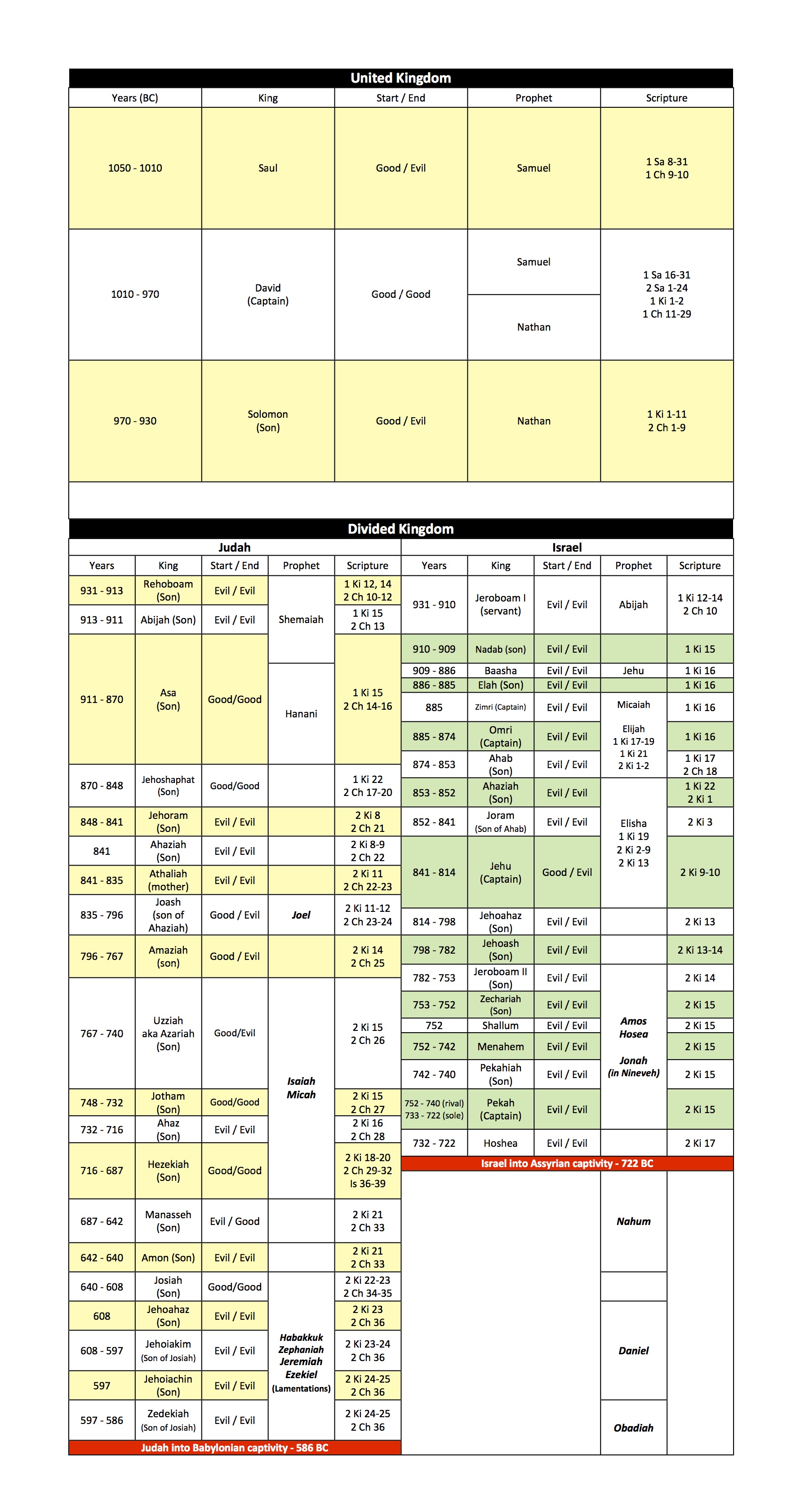
Judges of Israel, Kings of Israel and Judah

Doing some research lately on the pre-exilic and exilic periods of the Old Testament (building on what I wrote on this blog four years ago), I searched for a list that I used to have, with the rulers and kings of Israel and later Judah. I can't find that list now; it's around her somewhere. Luckily, I found several references online, so I'll save them here for future reference. Perhaps there is someone who is such a Bible scholar as to have all these long names and references memorized, but I'm not one!

Here is a discussion and map of the settlement of the tribes of Israel:
http://www.jewishvirtuallibrary.org/jsource/Judaism/tribes.html

Here is a chart of the judges of Israel, along with the peoples who threatened Israel:
http://www.bible-history.com/old-testament/judges.html

Here is a list of the judges, with the biblical references:
http://jesusalive.cc/ques349.htm

Here is a good chart with the Bible references along with approximate dates, the character of each monarch, AND the prophets associated with the different kings:
https://craigtowens.files.wordpress.com/2014/07/kings-of-israel-judah2.jpg

Also: https://www.biblegateway.com/blog/2014/08/chart-of-israels-and-judahs-kings-and-prophets/

Here is another, without the references, but which is also helpful:
http://www.ldolphin.org/kings.html

And yet another:
http://www.biblestudy.org/prophecy/israel-kings.html

And...
https://www.vtaide.com/gleanings/Kings-of-Israel/kings.html

It would be interesting to print out all these charts and to see different interpretations of the approximate years of each monarch along with the prophets. Some prophets are easier to locate in history than others; the book of Joel, for instance, has little or no internal indication of the writing's circumstances, and so to position Joel historically is conjectural. Also, Daniel narrates exilic circumstances but was written many years later.


Wednesday, March 16, 2016

Maundy Thursday and Good Friday Scriptures

The manuscript for my book, Walking with Jesus through the Old Testament (available here or here), had an appendix that contained allusions and quotations to Old Testament passages that, for the New Testament writers, were pertinent to Maundy Thursday and Good Friday. The appendix was omitted because it didn't fit the devotional quality of the rest of the book. But with my editor's permission, I'm posting that material here on this blog.

The Gospel accounts of Maundy Thursday and Good Friday are filled with allusions and quotations to Old Testament passages. The New Testament authors sought to demonstrate the messianic nature of Jesus by showing correspondence of Jesus' experiences with the biblical traditions. It is so difficult to discuss Holy Week scriptures without sounding anti-Jewish or anti-Semitic; the Gospels were written by Jews about other Jews, but as history moved along, Christianity became a predominantly Gentile religion, and the portrayal of Jews in the Gospels caused Christians to hate and persecute Jews. We must never forget this as we study the scriptures; in my book, I tried to show Jesus' continuity with the scriptures of his religion rather than to take a supersessionist approach.

With all that in mind: if you have time, look up some or all of these passages, so you can appreciate how the Gospel writers interpreted Jesus' experiences as deeply rooted in Hebrew scriptures. The way the Romans treated Jesus reflected their perception Jews as a troublesome people who, in their religious integrity, refused to respect the Roman gods.

Then [Jesus] said to them, “These are my words that I spoke to you while I was still with you—that everything written about me in the law of Moses, the prophets, and the psalms must be fulfilled.” Then he opened their minds to understand the scriptures, and he said to them, “Thus it is written, that the Messiah is to suffer and to rise from the dead on the third day, and that repentance and forgiveness of sins is to be proclaimed in his name to all nations, beginning from Jerusalem.
(Luke 24:44-47)

• Judas betrays Jesus (Ps. 41:9; Matt. 26:14–16; Mark 14:10–11; Luke 22:3–6; John 13:21–30) and receives thirty pieces of silver (Zech. 11:12–13; Matt. 26:14–16; 27:3–7).
• Jesus’ friends abandon him; the sheep are scattered after the shepherd is struck (Ps. 38:11; Zech. 13:7; Mark 14:50).
• The witnesses accuse him (Ps. 27:12; 35:11–12; Matt. 26:59¬–61; Mark 14:55–57).
• Jesus is silent before his accusers (Isa. 53:7; Matt. 27:13–14; Mark 15:3–-5); he does not respond to them with deceit or violence (Isa. 53:12; 1 Pet. 2:22); but he testifies to the victory of the Son of Man (Ps. 110:1; Dan. 7:13; Matt. 26:64; Mark 14:62; Luke 22:67–70).

For Good Friday, Old Testament passages connected to Jesus’ experiences are many.
• Satan will “bruise” him (Gen. 3:15; John 12:31–33; 19:18).
• Jesus will suffer for the world (Isa. 53:4–6, 10-11; Rom. 5:6–9).
• Jesus experienced insults, rejection, and abuse (Isa. 49:7; 50:6; Ps. 22:8; Matt. 27:41–44; Mark 15:31–32;, Luke 23:35–38). He is spat upon (Isa. 50:6; Matt. 27:30; Mark 15:19). People gloat (Ps. 22:12–13, 16; 38:11; 109:25; Matt. 27:39–40;, Mark 15:29–30; Luke 23:35), and they reproach him and mock him (Ps. 22:6–8, 16–18; 44:13–16; 109:25; Matt. 27:27–31, 39–40; Mark 15:16–20, 25–32; Luke 23:35–36;, John 19:19–20).
• He is led as a “lamb to the slaughter” (Exod. 12:3–13; Ps. 44:11; Isa. 53:7; John 1:29; 1 Cor. 5:7).
• He is disfigured and brutalized (Isa. 52:14; Ps. 22:16–17; Matt. 27:26; Mark 15:2; John 19:1–3).
• He is pierced (Ps. 22:16; Zech. 12:10; John 19:33–37; 20:25–27).
• His betrayer dies and the money is used for a potter’s field (Jer. 18:2–3; 32:6–15; Zech. 11:12–13; Matt. 27:3–10).
• He is executed with criminals (Isa. 53:12; Matt. 21:38, 44; Mark 15:27; Luke 23:32–33; 39–43; John 19:18).
• He expresses thirst (Ps. 69:21; John 19:28).
• He is given vinegar to drink (Ps. 69:21; Matt. 27:48; Mark 15:36; Luke 23:36).
• Lots are cast for his clothing (Ps. 22:18; Matt. 27:35;, Mark 15:24; Luke 23:34; John 19:24).
• He makes intercession for those who kill and mock him, and he invokes the compassion of God for them (Isa. 53:12; Luke 23:34, 39–43; Acts 2:36–39).
• He cries, “My God, my God, why have you forsaken me?” which is the first line of Psalm 22 (Matt. 27:46; Mark 15:34).
• He experiences the onslaught of death (Ps. 69:15).
• He declares, “It is finished” (Ps. 22:31; John 19:30).
• He prays, “Father, into your hands I commend my spirit,” which is taken from Psalm 31:5 (Luke 23:46).
• Romans did not break Jesus’ legs, which would have hastened his death; that his bones were not broken connects us to Psalm 34:20, as well as to Passover Scriptures like Exodus 12:43–46 and Numbers 9:12. These Passover texts, in turn, connect us back to the image of Jesus as the Lamb of God.
• God did not abandon Jesus to death, corruption, and anonymity (2 Sam. 7:12–13; Ps. 16:10; Acts 2:31, 31–32).
• He is given another man’s grave (Isa. 53:8–9; Matt. 27:57–61; Mark 15:42–47; Luke 23:50–56;
John 19:38–42).
• Jesus accomplishes God’s salvation (Isa. 25:8, and many others).

Remember that nearly all these Psalm references come from Psalms of King David, connecting Jesus’ sufferings with those of his ancestor David and thus saying something about the kind of monarch Jesus is affirmed to be.

Thursday, March 3, 2016

"The Love of Bible Study"

During the 00s, I worked on a book manuscript of my own (rather than a commissioned work or one resulting from a successful proposal), that was an experiment which, ultimately, found no interested publisher. The title was The Love of Bible Study, and the text can be found here. I wrote as an introduction:

"For many years I’ve written church curriculum aimed at helping people understand the Bible, apply it to personal life, and interpret the text concerning modern topics. For an even longer time, I’ve read the Bible in order to grow in my faith, to clarify God’s will and purposes. For me, reading the Bible is a great joy!

"A few years ago I purchased a new NRSV Bible to replace (but more usually to supplement) the worn old Bible I’ve used since I purchased it for a college course in 1977.  Approaching my 50th birthday, I decided to take notes as I compared the two Bibles. Beginning with that time of midlife spiritual renewal, my notes became a blog called “Changing Bibles,” and then I “farmed out” the posts at that site to this one, and also to a companion site to this one (called Bible Connections), and to yet another site that focuses upon Psalm 121. So these four sites of informal notes and reveries are interconnected as the results of a common midlife resolution to study the Bible anew. My resolution clearly got out of hand, but in a good way.

"At first I hoped that the contents of the present blog would become a published book. But the material did not fit comfortably into a genre: academic study, curriculum, or memoir. So I stopped sending queries to publishers and “cut to the chase” by making my studies available to readers in this online form.

"Thereby, I hope I can help you—you who found this site—discover favorite scriptural passages of your own, and give you a fresh appreciation of the Bible, lengthy and intimidating though it can be for many of us.    

"As we study the Bible, we seek not only to understand things about the Lord but also to seek the Lord himself.  It can be easy for us to forget that the living Christ is right now helping us as we read and study. Thus my blog title has a double sense: we grow in enjoyment of Bible study so that we look forward to it, but we also grow in love of God and one another. We connect Bible passages to Christ, and as we do so we see how the living Christ and the Holy Spirit is present to us today, helping us learn and grow and draw closer to the triune Lord who has already accomplished more than we could think or ask (Eph. 3:20-21).

"Please feel free to comment and raise topics and questions, so that we can have a conversation about faith and life. Also, please feel free simply to browse. I managed to refer to every biblical book (even tiny Obadiah and 3 John), and I quoted or cited a few passages in the Apocrypha, the Talmud, and the Dhammapada. If anything here is helpful enough for you to use, you may certainly do so but if you quote something, please indicate the source."

The site has had only a very modest viewership, a few thousand during the last few years, but hopefully some have found it helpful. It certainly was to me, as I delved into the scriptures with that out-of-hand interest of which I wrote above.