Doing some research lately on the pre-exilic and exilic periods of the Old Testament (building on what I wrote on this blog four years ago), I searched for a list that I used to have, with the rulers and kings of Israel and later Judah. I can't find that list now; it's around her somewhere. Luckily, I found several references online, so I'll save them here for future reference. Perhaps there is someone who is such a Bible scholar as to have all these long names and references memorized, but I'm not one!
Here is a discussion and map of the settlement of the tribes of Israel:
http://www.jewishvirtuallibrary.org/jsource/Judaism/tribes.html
Here is a chart of the judges of Israel, along with the peoples who threatened Israel:
http://www.bible-history.com/old-testament/judges.html
Here is a list of the judges, with the biblical references:
http://jesusalive.cc/ques349.htm
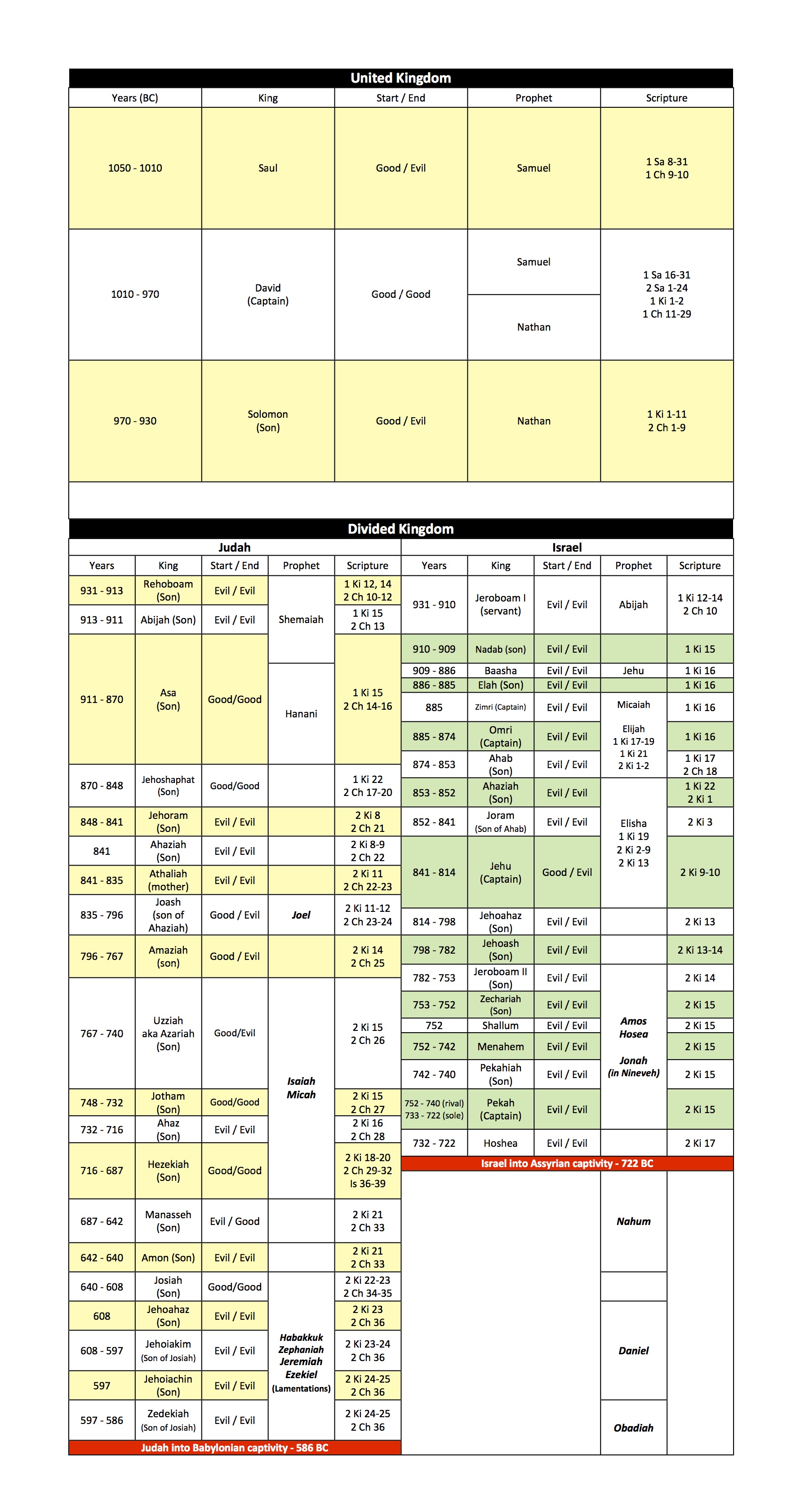
Here is a good chart with the Bible references along with approximate dates, the character of each monarch, AND the prophets associated with the different kings:
https://craigtowens.files.wordpress.com/2014/07/kings-of-israel-judah2.jpg
Also: https://www.biblegateway.com/blog/2014/08/chart-of-israels-and-judahs-kings-and-prophets/
Here is another, without the references, but which is also helpful:
http://www.ldolphin.org/kings.html
And yet another:
http://www.biblestudy.org/prophecy/israel-kings.html
And...
https://www.vtaide.com/gleanings/Kings-of-Israel/kings.html
It would be interesting to print out all these charts and to see different interpretations of the approximate years of each monarch along with the prophets. Some prophets are easier to locate in history than others; the book of Joel, for instance, has little or no internal indication of the writing's circumstances, and so to position Joel historically is conjectural. Also, Daniel narrates exilic circumstances but was written many years later.
.JPG)
Friday, April 8, 2016

Wednesday, March 16, 2016
Maundy Thursday and Good Friday Scriptures

The Gospel accounts of Maundy Thursday and Good Friday are filled with allusions and quotations to Old Testament passages. The New Testament authors sought to demonstrate the messianic nature of Jesus by showing correspondence of Jesus' experiences with the biblical traditions. It is so difficult to discuss Holy Week scriptures without sounding anti-Jewish or anti-Semitic; the Gospels were written by Jews about other Jews, but as history moved along, Christianity became a predominantly Gentile religion, and the portrayal of Jews in the Gospels caused Christians to hate and persecute Jews. We must never forget this as we study the scriptures; in my book, I tried to show Jesus' continuity with the scriptures of his religion rather than to take a supersessionist approach.
With all that in mind: if you have time, look up some or all of these passages, so you can appreciate how the Gospel writers interpreted Jesus' experiences as deeply rooted in Hebrew scriptures. The way the Romans treated Jesus reflected their perception Jews as a troublesome people who, in their religious integrity, refused to respect the Roman gods.
Then [Jesus] said to them, “These are my words that I spoke to you while I was still with you—that everything written about me in the law of Moses, the prophets, and the psalms must be fulfilled.” Then he opened their minds to understand the scriptures, and he said to them, “Thus it is written, that the Messiah is to suffer and to rise from the dead on the third day, and that repentance and forgiveness of sins is to be proclaimed in his name to all nations, beginning from Jerusalem.
(Luke 24:44-47)
• Judas betrays Jesus (Ps. 41:9; Matt. 26:14–16; Mark 14:10–11; Luke 22:3–6; John 13:21–30) and receives thirty pieces of silver (Zech. 11:12–13; Matt. 26:14–16; 27:3–7).
• Jesus’ friends abandon him; the sheep are scattered after the shepherd is struck (Ps. 38:11; Zech. 13:7; Mark 14:50).
• The witnesses accuse him (Ps. 27:12; 35:11–12; Matt. 26:59¬–61; Mark 14:55–57).
• Jesus is silent before his accusers (Isa. 53:7; Matt. 27:13–14; Mark 15:3–-5); he does not respond to them with deceit or violence (Isa. 53:12; 1 Pet. 2:22); but he testifies to the victory of the Son of Man (Ps. 110:1; Dan. 7:13; Matt. 26:64; Mark 14:62; Luke 22:67–70).
For Good Friday, Old Testament passages connected to Jesus’ experiences are many.
• Satan will “bruise” him (Gen. 3:15; John 12:31–33; 19:18).
• Jesus will suffer for the world (Isa. 53:4–6, 10-11; Rom. 5:6–9).
• Jesus experienced insults, rejection, and abuse (Isa. 49:7; 50:6; Ps. 22:8; Matt. 27:41–44; Mark 15:31–32;, Luke 23:35–38). He is spat upon (Isa. 50:6; Matt. 27:30; Mark 15:19). People gloat (Ps. 22:12–13, 16; 38:11; 109:25; Matt. 27:39–40;, Mark 15:29–30; Luke 23:35), and they reproach him and mock him (Ps. 22:6–8, 16–18; 44:13–16; 109:25; Matt. 27:27–31, 39–40; Mark 15:16–20, 25–32; Luke 23:35–36;, John 19:19–20).
• He is led as a “lamb to the slaughter” (Exod. 12:3–13; Ps. 44:11; Isa. 53:7; John 1:29; 1 Cor. 5:7).
• He is disfigured and brutalized (Isa. 52:14; Ps. 22:16–17; Matt. 27:26; Mark 15:2; John 19:1–3).
• He is pierced (Ps. 22:16; Zech. 12:10; John 19:33–37; 20:25–27).
• His betrayer dies and the money is used for a potter’s field (Jer. 18:2–3; 32:6–15; Zech. 11:12–13; Matt. 27:3–10).
• He is executed with criminals (Isa. 53:12; Matt. 21:38, 44; Mark 15:27; Luke 23:32–33; 39–43; John 19:18).
• He expresses thirst (Ps. 69:21; John 19:28).
• He is given vinegar to drink (Ps. 69:21; Matt. 27:48; Mark 15:36; Luke 23:36).
• Lots are cast for his clothing (Ps. 22:18; Matt. 27:35;, Mark 15:24; Luke 23:34; John 19:24).
• He makes intercession for those who kill and mock him, and he invokes the compassion of God for them (Isa. 53:12; Luke 23:34, 39–43; Acts 2:36–39).
• He cries, “My God, my God, why have you forsaken me?” which is the first line of Psalm 22 (Matt. 27:46; Mark 15:34).
• He experiences the onslaught of death (Ps. 69:15).
• He declares, “It is finished” (Ps. 22:31; John 19:30).
• He prays, “Father, into your hands I commend my spirit,” which is taken from Psalm 31:5 (Luke 23:46).
• Romans did not break Jesus’ legs, which would have hastened his death; that his bones were not broken connects us to Psalm 34:20, as well as to Passover Scriptures like Exodus 12:43–46 and Numbers 9:12. These Passover texts, in turn, connect us back to the image of Jesus as the Lamb of God.
 • God did not abandon Jesus to death, corruption, and anonymity (2 Sam. 7:12–13; Ps. 16:10; Acts 2:31, 31–32).
• He is given another man’s grave (Isa. 53:8–9; Matt. 27:57–61; Mark 15:42–47; Luke 23:50–56;
John 19:38–42).
• Jesus accomplishes God’s salvation (Isa. 25:8, and many others).
Remember that nearly all these Psalm references come from Psalms of King David, connecting Jesus’ sufferings with those of his ancestor David and thus saying something about the kind of monarch Jesus is affirmed to be.
Thursday, March 3, 2016
"The Love of Bible Study"
During the 00s, I worked on a book manuscript of my own (rather than a commissioned work or one resulting from a successful proposal), that was an experiment which, ultimately, found no interested publisher. The title was The Love of Bible Study, and the text can be found here. I wrote as an introduction:
"For many years I’ve written church curriculum aimed at helping people understand the Bible, apply it to personal life, and interpret the text concerning modern topics. For an even longer time, I’ve read the Bible in order to grow in my faith, to clarify God’s will and purposes. For me, reading the Bible is a great joy!
"A few years ago I purchased a new NRSV Bible to replace (but more usually to supplement) the worn old Bible I’ve used since I purchased it for a college course in 1977. Approaching my 50th birthday, I decided to take notes as I compared the two Bibles. Beginning with that time of midlife spiritual renewal, my notes became a blog called “Changing Bibles,” and then I “farmed out” the posts at that site to this one, and also to a companion site to this one (called Bible Connections), and to yet another site that focuses upon Psalm 121. So these four sites of informal notes and reveries are interconnected as the results of a common midlife resolution to study the Bible anew. My resolution clearly got out of hand, but in a good way.
"At first I hoped that the contents of the present blog would become a published book. But the material did not fit comfortably into a genre: academic study, curriculum, or memoir. So I stopped sending queries to publishers and “cut to the chase” by making my studies available to readers in this online form.
"Thereby, I hope I can help you—you who found this site—discover favorite scriptural passages of your own, and give you a fresh appreciation of the Bible, lengthy and intimidating though it can be for many of us.
"As we study the Bible, we seek not only to understand things about the Lord but also to seek the Lord himself. It can be easy for us to forget that the living Christ is right now helping us as we read and study. Thus my blog title has a double sense: we grow in enjoyment of Bible study so that we look forward to it, but we also grow in love of God and one another. We connect Bible passages to Christ, and as we do so we see how the living Christ and the Holy Spirit is present to us today, helping us learn and grow and draw closer to the triune Lord who has already accomplished more than we could think or ask (Eph. 3:20-21).
"Please feel free to comment and raise topics and questions, so that we can have a conversation about faith and life. Also, please feel free simply to browse. I managed to refer to every biblical book (even tiny Obadiah and 3 John), and I quoted or cited a few passages in the Apocrypha, the Talmud, and the Dhammapada. If anything here is helpful enough for you to use, you may certainly do so but if you quote something, please indicate the source."
The site has had only a very modest viewership, a few thousand during the last few years, but hopefully some have found it helpful. It certainly was to me, as I delved into the scriptures with that out-of-hand interest of which I wrote above.
"For many years I’ve written church curriculum aimed at helping people understand the Bible, apply it to personal life, and interpret the text concerning modern topics. For an even longer time, I’ve read the Bible in order to grow in my faith, to clarify God’s will and purposes. For me, reading the Bible is a great joy!
"A few years ago I purchased a new NRSV Bible to replace (but more usually to supplement) the worn old Bible I’ve used since I purchased it for a college course in 1977. Approaching my 50th birthday, I decided to take notes as I compared the two Bibles. Beginning with that time of midlife spiritual renewal, my notes became a blog called “Changing Bibles,” and then I “farmed out” the posts at that site to this one, and also to a companion site to this one (called Bible Connections), and to yet another site that focuses upon Psalm 121. So these four sites of informal notes and reveries are interconnected as the results of a common midlife resolution to study the Bible anew. My resolution clearly got out of hand, but in a good way.
"At first I hoped that the contents of the present blog would become a published book. But the material did not fit comfortably into a genre: academic study, curriculum, or memoir. So I stopped sending queries to publishers and “cut to the chase” by making my studies available to readers in this online form.
"Thereby, I hope I can help you—you who found this site—discover favorite scriptural passages of your own, and give you a fresh appreciation of the Bible, lengthy and intimidating though it can be for many of us.
"As we study the Bible, we seek not only to understand things about the Lord but also to seek the Lord himself. It can be easy for us to forget that the living Christ is right now helping us as we read and study. Thus my blog title has a double sense: we grow in enjoyment of Bible study so that we look forward to it, but we also grow in love of God and one another. We connect Bible passages to Christ, and as we do so we see how the living Christ and the Holy Spirit is present to us today, helping us learn and grow and draw closer to the triune Lord who has already accomplished more than we could think or ask (Eph. 3:20-21).
"Please feel free to comment and raise topics and questions, so that we can have a conversation about faith and life. Also, please feel free simply to browse. I managed to refer to every biblical book (even tiny Obadiah and 3 John), and I quoted or cited a few passages in the Apocrypha, the Talmud, and the Dhammapada. If anything here is helpful enough for you to use, you may certainly do so but if you quote something, please indicate the source."
The site has had only a very modest viewership, a few thousand during the last few years, but hopefully some have found it helpful. It certainly was to me, as I delved into the scriptures with that out-of-hand interest of which I wrote above.
Friday, February 26, 2016
"Walking with Jesus through the Old Testament"

I begin with the story of the walk to Emmaus in Luke 24, which includes the verse: “Then beginning with Moses and all the prophets, [Jesus] interpreted to them the things about himself in all the scriptures” (verse 27). Later, Jesus’ two friends declare, “Were not our hearts burning within us while he was talking to us on the road, while he was opening the scriptures to us?” (verse 32). Although we don’t know which scriptures Jesus discussed, I chose forty Old Testament passages that are especially important for understanding Christ, and wrote meditations on each passage for each of the days of Lent. I began with Jesus' beginnings, moved through the early days of his ministry, connected him with great themes of the Old Testament and with significant Old Testament figures, and then concluded with Holy Week, Easter, and the Holy Spirit. Each day includes a prayer and at least one spiritual exercise.
My hope is that people will enjoy the book as a Lenten study, but it can also be used outside of Lent as a study of important Old Testament passages, and a clarification of its relationship with the New. I stress continuity of the two testaments and try very hard to avoid supersessionism. Many Christians don't care much for the Old Testament, but I love it and wish that more Christians loved and understood it better. So I've hopes that the Spirit can use the book to help folks delve more deeply into the sacred scriptures.
The 613 Mitzvot
A couple years ago, I posted some aspects about the Torah, here. Lately I've been studying a wonderful book book by Harvey J. Fields, A Torah Commentary for Our Times, Volume Two: Exodus and Leviticus (New York: URI Press, 1991). In the chapter on the Parashat Mishpatim (the Torah portion Exodus 21:1-24:18: parashat means section and mishpatim means laws or rules), the author notes that this is not the only Torah section dealing with laws and mitzvot, which are found throughout the Torah, but it does begin a listing of laws following the giving of the Ten Commandments. The author notes that the 4th century Rabbi Simlai was perhaps the first to ask how many mitzvot are given in the Torah, and he gave the classic answer, agreed upon by Rambam (Maimonides): 248 positive commands (“you shall...”) and 365 negative ones (“you shall not...”). The number corresponds to the parts of the human body and the days of the solar year, respectively (p. 53). Other rabbis distinguished mitzvot bein adam le-Makom, or mitzvot “between human being and God”) and mitzvot bein adam le-chavero, mitzvot between a person and other persons. But this distinction between ritual and ethical commandments doesn’t imply that one is more important than the other, and rituals often lead to proper ethical actions (p. 54).
An aside: I know that this is a common Christian idea about the Torah: that ethical commandments are more important than the rituals. That may be true for Christians, but there is no basis in the text or in Jewish tradition.
Another aside: a rabbi friend tells me that about 300 laws can still be observed today. Those that pertain to the Temple, priesthood and sacrifices are not observed because those institutions no longer exist in Judaism, although even those laws can be studied and meditated upon today. Other laws are certainly followed by Jews today, although Jews do differ on issues of contemporary interpretation (just as Christians differ among themselves about biblical topics).
The author Harvey Fields discusses the views of Maimonides and other teachers, that the commandments are given to Jews by God in order to uplift one’s life to God’s will and to submit oneself to discipline (pp. 54-55). This includes the commandments that seem to have no particular connection to ethical improvement, or those for which the meaning is no longer understood. By practicing and/or meditating on the meaning of mitzvot, “we become more just and loving and add to the good n our lives and in the world” (p. 55).
Fields concludes, “the 613 commandments form the essential core of Jewish practice and tradition. Their blend of both the ethical and ritual is unique” (p. 56), for other religions tend to separate the two kinds of teaching.
How about the laws themselves? The Judaism 101 site has a helpful listening of the laws, arranged topically: http://www.jewfaq.org/613.htm She indicates which laws can still be followed and provides the scripture links.
The book I cited in that earlier post is by a Presbyterian author, William J. Doorly, The Laws of Yahweh: A Handbook of Biblical Laws (New York: Paulist Press, 2002). Chapter 6 gives all the laws in order.
Rabbi Joseph Telushkin has a wonderful book, from which I've taken notes elsewhere in this blog: Biblical Literacy: The Most Important People, Evens, and Ideas of the Hebrew Bible (New York: William Morrow, 1997). Part Two pertains to "laws and ideas" (pp. 397-510). Then Part Three gives a short summary and/or discussion of all the laws in order of appearance (pp. 511-592).
An aside: I know that this is a common Christian idea about the Torah: that ethical commandments are more important than the rituals. That may be true for Christians, but there is no basis in the text or in Jewish tradition.
Another aside: a rabbi friend tells me that about 300 laws can still be observed today. Those that pertain to the Temple, priesthood and sacrifices are not observed because those institutions no longer exist in Judaism, although even those laws can be studied and meditated upon today. Other laws are certainly followed by Jews today, although Jews do differ on issues of contemporary interpretation (just as Christians differ among themselves about biblical topics).
The author Harvey Fields discusses the views of Maimonides and other teachers, that the commandments are given to Jews by God in order to uplift one’s life to God’s will and to submit oneself to discipline (pp. 54-55). This includes the commandments that seem to have no particular connection to ethical improvement, or those for which the meaning is no longer understood. By practicing and/or meditating on the meaning of mitzvot, “we become more just and loving and add to the good n our lives and in the world” (p. 55).
Fields concludes, “the 613 commandments form the essential core of Jewish practice and tradition. Their blend of both the ethical and ritual is unique” (p. 56), for other religions tend to separate the two kinds of teaching.
How about the laws themselves? The Judaism 101 site has a helpful listening of the laws, arranged topically: http://www.jewfaq.org/613.htm She indicates which laws can still be followed and provides the scripture links.
The book I cited in that earlier post is by a Presbyterian author, William J. Doorly, The Laws of Yahweh: A Handbook of Biblical Laws (New York: Paulist Press, 2002). Chapter 6 gives all the laws in order.
Rabbi Joseph Telushkin has a wonderful book, from which I've taken notes elsewhere in this blog: Biblical Literacy: The Most Important People, Evens, and Ideas of the Hebrew Bible (New York: William Morrow, 1997). Part Two pertains to "laws and ideas" (pp. 397-510). Then Part Three gives a short summary and/or discussion of all the laws in order of appearance (pp. 511-592).
Sunday, January 17, 2016
Tribute to Brevard S. Childs
When I attended the Society of Biblical Literature convention this past November, I purchased a book that I'd not yet seen, The Bible as Christian Scripture: The Work of Brevard S. Childs, edited by Christopher R. Seitz and Kent Harold Richards.
Childs (1923-2007), was professor of Old Testament at Yale in 1958 till 1999 (and Sterling Professor in 1992-1999) He was known for his "canonical criticism," which focused upon the biblical text as canon, in contrast to the historical-critical method. He wrote several books, a notable one of which was Introduction to the Old Testament as Scripture (1979). I was very privileged to have him as my Old Testament professor at Yale Divinity School during the Fall 1979 semester, when that book was just beginning to be discussed. I am diligently searching for a letter he wrote to me in the early 00s in response to a grateful letter that I had sent to him.
During these past several years of renewing my personal Bible study, I've enjoyed studying again not only his Introduction book but some of his others. The past few weeks I've been enjoying reading through Seitz's and Richards' book, a tribute and assessment of Childs' work. (I didn't know Seitz but I vaguely remember that he was an Old Testament doctoral student at the time I did my masters degree there.)
The contents of the book:
Preface by Christopher R. Seitz
The Works of Brevard Springs Childs
Tribute to Brevard S. Childs, at the International SBL Meeting in Vienna, Austria, by Christopher R. Seitz.
Brevard Childs and Form Criticism, by David L. Petersen
The Wrath of God at Mount Sinai (Exod 32; Deut 9–10), by Jörg Jeremias
The Contrastive Unity of Scripture: On the Hermeneutics of the Biblical Canon, by Bernd Kanowski
Brevard Childs as a Historical Critic: Divine Concession and the Unity of the Canon, by Stephen B. Chapman
Theological Interpretation, the Historical Formation of Scripture, and God’s Action in Time, by Neil B. MacDonald
Faith Seeking Canonical Understanding: Childs’s Guide to the Pauline Letters, by Leander E. Keck
Childs and the History of Interpretation, by Mark W. Elliott
Biblical Theology and the Communicative Presence of God, by Murray A. Rae
The Doctrine of God is a Hermeneutic: The Biblical Theology of Brevard S. Childs, by C. Kavin Rowe
A Shared Reality: Ontology in Brevard Childs’s Isaiah Commentary, by Mark Gignilliat
A Tale of Two Testaments: Childs, Old Testament Torah, and Heilsgeschichte, by Don Collett
Reflections on the Rule of Faith, by Leonard G. Finn
Childs and the Canon or Rule of Faith, by Daniel R. Driver
Psalm 34: Redaction, Inner-Biblical Exegesis and the Longer Psalm Superscriptions—“Mistake” Making and Theological Significance, by Christopher R. Seitz
Allegory and Typology within Biblical Interpretation, by Brevard S. Childs
Childs (1923-2007), was professor of Old Testament at Yale in 1958 till 1999 (and Sterling Professor in 1992-1999) He was known for his "canonical criticism," which focused upon the biblical text as canon, in contrast to the historical-critical method. He wrote several books, a notable one of which was Introduction to the Old Testament as Scripture (1979). I was very privileged to have him as my Old Testament professor at Yale Divinity School during the Fall 1979 semester, when that book was just beginning to be discussed. I am diligently searching for a letter he wrote to me in the early 00s in response to a grateful letter that I had sent to him.
During these past several years of renewing my personal Bible study, I've enjoyed studying again not only his Introduction book but some of his others. The past few weeks I've been enjoying reading through Seitz's and Richards' book, a tribute and assessment of Childs' work. (I didn't know Seitz but I vaguely remember that he was an Old Testament doctoral student at the time I did my masters degree there.)
The contents of the book:
Preface by Christopher R. Seitz
The Works of Brevard Springs Childs
Tribute to Brevard S. Childs, at the International SBL Meeting in Vienna, Austria, by Christopher R. Seitz.
Brevard Childs and Form Criticism, by David L. Petersen
The Wrath of God at Mount Sinai (Exod 32; Deut 9–10), by Jörg Jeremias
The Contrastive Unity of Scripture: On the Hermeneutics of the Biblical Canon, by Bernd Kanowski
Brevard Childs as a Historical Critic: Divine Concession and the Unity of the Canon, by Stephen B. Chapman
Theological Interpretation, the Historical Formation of Scripture, and God’s Action in Time, by Neil B. MacDonald
Faith Seeking Canonical Understanding: Childs’s Guide to the Pauline Letters, by Leander E. Keck
Childs and the History of Interpretation, by Mark W. Elliott
Biblical Theology and the Communicative Presence of God, by Murray A. Rae
The Doctrine of God is a Hermeneutic: The Biblical Theology of Brevard S. Childs, by C. Kavin Rowe
A Shared Reality: Ontology in Brevard Childs’s Isaiah Commentary, by Mark Gignilliat
A Tale of Two Testaments: Childs, Old Testament Torah, and Heilsgeschichte, by Don Collett
Reflections on the Rule of Faith, by Leonard G. Finn
Childs and the Canon or Rule of Faith, by Daniel R. Driver
Psalm 34: Redaction, Inner-Biblical Exegesis and the Longer Psalm Superscriptions—“Mistake” Making and Theological Significance, by Christopher R. Seitz
Allegory and Typology within Biblical Interpretation, by Brevard S. Childs
Thursday, May 21, 2015
The Pentateuch
This past winter, before the hectic semester began, I took notes from the enjoyable article on the Pentateuch in the New Interpreter’s Bible Dictionary. The author, R. W. L. Moberly, discusses issues of interpretation and content. For instance, narrative tensions can be found throughout the various books. Isaac’s blessing of his two sons (Genesis 27) implies that Isaac was near death; but Isaac died years later, after Jacob returns from his fourteen years with Laban (Genesis 29:15-30, 35:27-29) (p. 432). The number of Israelites who left Egypt seem to be a comparatively smaller group---that can be accommodated by twelve springs and by water produced from a rock (Ex. 15:27, 17:6). But elsewhere the narrative describes the group as 600,000 men on food, not including women and children, or nearly two millions people (p. 433).
Another contrast is the status of women: Exodus 20:17 places “wife” after “house,” while the corresponding commandment in Deuteronomy (5:21) places wife before house. Similarly, Deuteronomy 22:22 makes a woman accountable for her actions, although in Genesis, when Sarah is taken into Pharaoh’s harem (and later Abimelech’s), it is Abraham who is accountable (Genesis 12:18-19, 20:10) (p. 433).
Still another contrast is the difference between the Ten Commandments, usually in small details, but notably in the difference between the Exodus and Deuteronomy versions of the Sabbath commandment, where two different reasons for the commandment are given (Ex. 20:11, Deut. 5;15) (p. 433).
The article lists several similar examples, reflecting the different traditions that have been brought together in the writing and editing of what became the canonical text. But I was particularly interested in points made in the section "Genesis as ‘the Old Testament of the Old Testament’" (p. 434-435). The focus is on the fact that, in Exodus 3:13-15, God reveals the divine name to Moses as a new name, and in Exodus 6:2-3, it is stated that the patriarchs knew God, not as YHWH but as El Shaddai. But in Genesis, God uses the divine name (Gen. 15:7, 28:13), and the name is frequently used throughout the book (p. 434).
A possible explanation is that, for the hypothesized writers named as the Elohist and the Priestly sources, the divine name was made known to Moses but not before, while the source called the Jahwist used the divine name all along, in Genesis 2, in Gen. 4:26, and so on. Still, these different traditions were preserved together when Genesis was written. (Another explanation is that the divine name was familiar to the authors and used in the test, even if it is anachronistic: p. 435.)
Moberly writes that the divine name becomes attached to the covenant of Moses and therefore to holiness and exclusivity (as in Exodus 12, where the Egyptians did not known the true God.) And yet, the Lord named by the divine name YHWH is traditionally called the God of Abraham, Isaac, and Jacob---Moses' forebearers. As Moberly puts it, “The one God can apparently be known in markedly different ways. This poses the ancient problem: how should one recognize as religiously authoritative material that is full of religious practices different from or even forbidden by Mosaic torah (compare, e.g., Jacob’s setting up a pillar in Gene. 28:18 with the strong prohbition of such in Deut. 16:22)?” (p. 435).
Moberly suggests that the patriarchs “become types and/or figures of Israel” for instance, Abraham’s journey to Egypt. The Abraham stories aren’t rewritten to reflect later religious realities but they remain authoritative heritage for Israel. Christians, of course, do the same thing in their interepretation of Abraham, Moses, and other aspects of the Old Testament (p 435).
Another interesting point made in the article concerns the Shema, not only Deut. 6:4-5 but also Deut. 6:6-9. Christians tend to ignore 6-9 as Jewish practices. Yet Christians feel scriptural obligations to follow other teachings of scripture (as in the "do this" of 1 Cor. 11:23-26, et al.). It’s just that Christians have appropriated other practices for their own heritage. "Of course, some Christians traditionally have practiced equivalent to those of Deut. 6:6-9, most obviously int he regular recital of the Lord's Prayer and in the display of the prime Christian symbol of the cross---often on a necklace but also over the gates of critics in the historic Christian empire of Byzantium, where they symbolically depicted the identity and allegiance of the place one was entering, just as Deut. 6:9 envisages the working of the Shema doing for Israel's homes (private space) and cities (public space). Deuteronomy does not envisage the recital and display of an equivalent to the Shema, but of the Shema itself. Yet Christians only receive Deuteronomy as part of the larger canon of Scripture… and that makes the difference" (p. 437).
Another contrast is the status of women: Exodus 20:17 places “wife” after “house,” while the corresponding commandment in Deuteronomy (5:21) places wife before house. Similarly, Deuteronomy 22:22 makes a woman accountable for her actions, although in Genesis, when Sarah is taken into Pharaoh’s harem (and later Abimelech’s), it is Abraham who is accountable (Genesis 12:18-19, 20:10) (p. 433).
Still another contrast is the difference between the Ten Commandments, usually in small details, but notably in the difference between the Exodus and Deuteronomy versions of the Sabbath commandment, where two different reasons for the commandment are given (Ex. 20:11, Deut. 5;15) (p. 433).
The article lists several similar examples, reflecting the different traditions that have been brought together in the writing and editing of what became the canonical text. But I was particularly interested in points made in the section "Genesis as ‘the Old Testament of the Old Testament’" (p. 434-435). The focus is on the fact that, in Exodus 3:13-15, God reveals the divine name to Moses as a new name, and in Exodus 6:2-3, it is stated that the patriarchs knew God, not as YHWH but as El Shaddai. But in Genesis, God uses the divine name (Gen. 15:7, 28:13), and the name is frequently used throughout the book (p. 434).
A possible explanation is that, for the hypothesized writers named as the Elohist and the Priestly sources, the divine name was made known to Moses but not before, while the source called the Jahwist used the divine name all along, in Genesis 2, in Gen. 4:26, and so on. Still, these different traditions were preserved together when Genesis was written. (Another explanation is that the divine name was familiar to the authors and used in the test, even if it is anachronistic: p. 435.)
Moberly writes that the divine name becomes attached to the covenant of Moses and therefore to holiness and exclusivity (as in Exodus 12, where the Egyptians did not known the true God.) And yet, the Lord named by the divine name YHWH is traditionally called the God of Abraham, Isaac, and Jacob---Moses' forebearers. As Moberly puts it, “The one God can apparently be known in markedly different ways. This poses the ancient problem: how should one recognize as religiously authoritative material that is full of religious practices different from or even forbidden by Mosaic torah (compare, e.g., Jacob’s setting up a pillar in Gene. 28:18 with the strong prohbition of such in Deut. 16:22)?” (p. 435).
Moberly suggests that the patriarchs “become types and/or figures of Israel” for instance, Abraham’s journey to Egypt. The Abraham stories aren’t rewritten to reflect later religious realities but they remain authoritative heritage for Israel. Christians, of course, do the same thing in their interepretation of Abraham, Moses, and other aspects of the Old Testament (p 435).
Another interesting point made in the article concerns the Shema, not only Deut. 6:4-5 but also Deut. 6:6-9. Christians tend to ignore 6-9 as Jewish practices. Yet Christians feel scriptural obligations to follow other teachings of scripture (as in the "do this" of 1 Cor. 11:23-26, et al.). It’s just that Christians have appropriated other practices for their own heritage. "Of course, some Christians traditionally have practiced equivalent to those of Deut. 6:6-9, most obviously int he regular recital of the Lord's Prayer and in the display of the prime Christian symbol of the cross---often on a necklace but also over the gates of critics in the historic Christian empire of Byzantium, where they symbolically depicted the identity and allegiance of the place one was entering, just as Deut. 6:9 envisages the working of the Shema doing for Israel's homes (private space) and cities (public space). Deuteronomy does not envisage the recital and display of an equivalent to the Shema, but of the Shema itself. Yet Christians only receive Deuteronomy as part of the larger canon of Scripture… and that makes the difference" (p. 437).
Subscribe to:
Posts (Atom)